

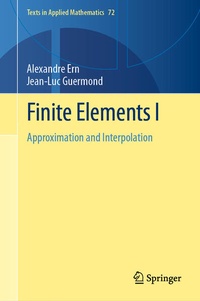
Finite Elements I
Approximation and Interpolation
1st Edition
Published on 19. February 2021
Book
Hardback
XII, 325 pages
978-3-030-56340-0 (ISBN)
Description
This book is the first volume of a three-part textbook suitable for graduate coursework, professional engineering and academic research. It is also appropriate for graduate flipped classes. Each volume is divided into short chapters. Each chapter can be covered in one teaching unit and includes exercises as well as solutions available from a dedicated website. The salient ideas can be addressed during lecture, with the rest of the content assigned as reading material. To engage the reader, the text combines examples, basic ideas, rigorous proofs, and pointers to the literature to enhance scientific literacy.
Volume I is divided into 23 chapters plus two appendices on Banach and Hilbert spaces and on differential calculus. This volume focuses on the fundamental ideas regarding the construction of finite elements and their approximation properties. It addresses the all-purpose Lagrange finite elements, but also vector-valued finite elements that are crucial to approximate the divergence and the curl operators. In addition, it also presents and analyzes quasi-interpolation operators and local commuting projections. The volume starts with four chapters on functional analysis, which are packed with examples and counterexamples to familiarize the reader with the basic facts on Lebesgue integration and weak derivatives. Volume I also reviews important implementation aspects when either developing or using a finite element toolbox, including the orientation of meshes and the enumeration of the degrees of freedom.More details
Product info
HC runder Rücken kaschiert
Series
Edition
1st ed. 2021
Language
English
Place of publication
Cham
Switzerland
Publishing group
Springer International Publishing
Target group
Professional and scholarly
College/higher education
Illustrations
90
90 s/w Abbildungen
XII, 325 p. 90 illus.
Dimensions
Height: 241 mm
Width: 160 mm
Thickness: 23 mm
Weight
738 gr
ISBN-13
978-3-030-56340-0 (9783030563400)
DOI
10.1007/978-3-030-56341-7
Schweitzer Classification
Other editions
Additional editions
Book
02/2022
1st Edition
Springer
€58.84
Shipment within 7-9 days
E-Book
02/2021
Springer
€56.99
Available for download
Persons
Alexandre Ern is Senior Researcher at Ecole des Ponts and INRIA in Paris, and he is also Associate Professor of Numerical Analysis at Ecole Polytechnique, Paris. His research deals with the devising and analysis of finite element methods and a posteriori error estimates and adaptivity with applications to fluid and solid mechanics and porous media flows. Alexandre Ern has co-authored three books and over 150 papers in peer-reviewed journals. He has supervised about 20 PhD students and 10 post-doctoral fellows, and he has ongoing collaborations with several industrial partners.
Jean-Luc Guermond is Professor of Mathematics at Texas A&M University where he also holds an Exxon Mobile Chair in Computational Science. His current research interests are in numerical analysis, applied mathematics, and scientific computing. He has co-authored two books and over 170 research papers in peer-reviewed journals.
Alexandre Ern is Senior Researcher at Ecole des Ponts and INRIA in Paris, and he is also Associate Professor of Numerical Analysis at Ecole Polytechnique, Paris. His research deals with the devising and analysis of finite element methods and a posteriori error estimates and adaptivity with applications to fluid and solid mechanics and porous media flows. Alexandre Ern has co-authored three books and over 150 papers in peer-reviewed journals. He has supervised about 20 PhD students and 10 post-doctoral fellows, and he has ongoing collaborations with several industrial partners.
Jean-Luc Guermond is Professor of Mathematics at Texas A&M University where he also holds an Exxon Mobile Chair in Computational Science. His current research interests are in numerical analysis, applied mathematics, and scientific computing. He has co-authored two books and over 170 research papers in peer-reviewed journals.
Jean-Luc Guermond is Professor of Mathematics at Texas A&M University where he also holds an Exxon Mobile Chair in Computational Science. His current research interests are in numerical analysis, applied mathematics, and scientific computing. He has co-authored two books and over 170 research papers in peer-reviewed journals.
Alexandre Ern is Senior Researcher at Ecole des Ponts and INRIA in Paris, and he is also Associate Professor of Numerical Analysis at Ecole Polytechnique, Paris. His research deals with the devising and analysis of finite element methods and a posteriori error estimates and adaptivity with applications to fluid and solid mechanics and porous media flows. Alexandre Ern has co-authored three books and over 150 papers in peer-reviewed journals. He has supervised about 20 PhD students and 10 post-doctoral fellows, and he has ongoing collaborations with several industrial partners.
Jean-Luc Guermond is Professor of Mathematics at Texas A&M University where he also holds an Exxon Mobile Chair in Computational Science. His current research interests are in numerical analysis, applied mathematics, and scientific computing. He has co-authored two books and over 170 research papers in peer-reviewed journals.
Content
Part I: Elements of Functional Analysis.- Lebesgue spaces.- Weak derivatives and Sobolev spaces.- Traces and Poincare Inequalities.- Duality in Sobolev spaces.- Part II: Introduction to Finite Elements.- Main ideas and definitions.- One-dimensional finite elements and tensorization.- Simplicial finite elements.- Part III: Finite element interpolation.- Meshes.- Finite element generation.- Mesh orientation.- Local interpolation on affine meshes.- Local inverse and functional inequalities.- Local interpolation on non-affine meshes.- H(div) finite elements.- H(curl) finite elements.- Local interpolation in H(div) and H(curl) (I).- Local interpolation in H(div) and H(curl) (II).- Part IV: Finite element spaces.- From broken to conforming spaces.- Main properties of the conforming spaces.- Face gluing.- Construction of the connectivity classes.- Quasi-interpolation and best approximation.- Commuting quasi-interpolation.- Appendices.- Banach and Hillbert spaces.- Differential calculus.