

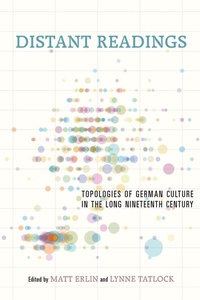
Distant Readings
Topologies of German Culture in the Long Nineteenth Century
Published on 1. May 2014
Book
Hardback
394 pages
978-1-57113-539-1 (ISBN)
Description
Explores the concept of "distant reading" and its application to the analysis of nineteenth-century German literature and culture, drawing on a range of approaches from the emerging digital humanities field.
In nineteenth-century Germany, breakthroughs in printing technology and an increasingly literate populace led to an unprecedented print production boom that has long presented scholars with a challenge: how to read it all? This anthology seeks new answers to the scholarly quandary of the abundance of text. Responding to Franco Moretti's call for "distant reading" and modeling a range of innovative approaches to literary-historical analysis informed by theburgeoning field of digital humanities, it asks what happens when we shift our focus from the one to the many, from the work to the network.
The thirteen essays in this volume explore the evolving concept of "distant reading"and its application to the analysis of German literature and culture in the long nineteenth century. The contributors consider how new digital technologies enable both the testing of hypotheses and the discovery of patterns and trends, as well as how "distant" and traditional "close" reading can complement each another in hybrid models of analysis that maintain careful attention to detail, but also make calculation, enumeration, and empirical descriptioncritical elements of interpretation.
Contributors: Kirsten Belgum, Tobias Boes, Matt Erlin, Fotis Jannidis and Gerhard Lauer, Lutz Koepnick, Todd Kontje, Peter M. McIsaac, Katja Mellmann, Nicolas Pethes, Andrew Piper and Mark Algee-Hewitt, Allen Beye Riddell, Lynne Tatlock, Paul A. Youngman and Ted Carmichael.
Matt Erlin is Professor of German and Chair of the Department of Germanic Languages and Literatures, and Lynne Tatlock is Hortense and Tobias Lewin Distinguished Professor in the Humanities, both at Washington University in St. Louis.
In nineteenth-century Germany, breakthroughs in printing technology and an increasingly literate populace led to an unprecedented print production boom that has long presented scholars with a challenge: how to read it all? This anthology seeks new answers to the scholarly quandary of the abundance of text. Responding to Franco Moretti's call for "distant reading" and modeling a range of innovative approaches to literary-historical analysis informed by theburgeoning field of digital humanities, it asks what happens when we shift our focus from the one to the many, from the work to the network.
The thirteen essays in this volume explore the evolving concept of "distant reading"and its application to the analysis of German literature and culture in the long nineteenth century. The contributors consider how new digital technologies enable both the testing of hypotheses and the discovery of patterns and trends, as well as how "distant" and traditional "close" reading can complement each another in hybrid models of analysis that maintain careful attention to detail, but also make calculation, enumeration, and empirical descriptioncritical elements of interpretation.
Contributors: Kirsten Belgum, Tobias Boes, Matt Erlin, Fotis Jannidis and Gerhard Lauer, Lutz Koepnick, Todd Kontje, Peter M. McIsaac, Katja Mellmann, Nicolas Pethes, Andrew Piper and Mark Algee-Hewitt, Allen Beye Riddell, Lynne Tatlock, Paul A. Youngman and Ted Carmichael.
Matt Erlin is Professor of German and Chair of the Department of Germanic Languages and Literatures, and Lynne Tatlock is Hortense and Tobias Lewin Distinguished Professor in the Humanities, both at Washington University in St. Louis.
Reviews / Votes
This is a cutting-edge publication in the field of German Studies, a shot across the bow of traditional scholarship. The essays are persuasively organized, and repeatedly place themselves in relationship to the ongoing debate on digital humanities. Precisely because of this debate, the book should have a significant impact on the field, and it may well turn into a model for potential digital work in other literary fields. This is an important topic, and one that we in the academy should not avoid. It is an opportunity to begin to envision different trajectories of distant reading in German. As the discussion around the digital humanities continues to develop, I see this potentially becoming a central element of the university. In fact, I believe that within a decade significant exposure to the digital humanities will be a required component of doctoral programs.-Russell Berman, Stanford University -- Russell Berman, Stanford University The volume . . . demonstrate[s] that there is still room for close readings, that the theoretical issues are not yet sorted out, and that we can look forward to any number of interesting analyses based on methods about which traditional scholarship has not yet dreamt. Distant Readings provides an excellent introduction to the issue, and it offers at least preliminary answers to questions whose relevance extends far beyond the nineteenth-century texts that it uses to map the controversy. * MONATSHEFTE * This outstanding volume . . . speaks to a constituency far beyond the field of German studies, making a bold and convincing claim that we can no longer be either in the 'for-camp' or the 'against-camp' when it comes to the digital humanities. Instead, by bringing distant and close readings together, we can only enrichen our discipline-both the questions we ask, and the answers we provide. -- Ben Schofield * JOURNAL OF EUROPEAN STUDIES *More details
Series
Language
English
Place of publication
Columbia, MD
United States
Publishing group
Boydell & Brewer Ltd
Target group
Professional and scholarly
Product notice
Cloth over boards
Illustrations
38 s/w Abbildungen, 40 farbige Abbildungen
40 colour, 38 b/w illus.
Dimensions
Height: 229 mm
Width: 152 mm
Weight
776 gr
ISBN-13
978-1-57113-539-1 (9781571135391)
Copyright in bibliographic data and cover images is held by Nielsen Book Services Limited or by the publishers or by their respective licensors: all rights reserved.
Schweitzer Classification
Other editions
Additional editions

Unknown | Matt Erlin | Lynne Tatlock
Distant Readings
Topologies of German Culture in the Long Nineteenth Century
E-Book
05/2014
1st Edition
Boydell & Brewer
€48.99
Available for download
Matt Erlin | Lynne Tatlock
Distant Readings
Topologies of German Culture in the Long Nineteenth Century
E-Book
05/2014
1st Edition
De Gruyter
€48.99
Available for download