

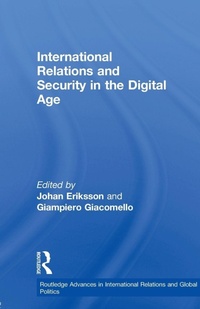
International Relations and Security in the Digital Age
1st Edition
Published on 30. July 2010
Book
Paperback/Softback
250 pages
978-0-415-59967-2 (ISBN)
Description
This book examines the impact of the information revolution on international and domestic security, attempting to remedy both the lack of theoretically informed analysis of information security and the US-centric tendency in the existing literature.
International Relations and Security in the Digital Age covers a range of topics, including: critical infrastructure protection, privacy issues, international cooperation, cyber terrorism, and security policy. It aims to analyze the impact of the information revolution on international and domestic security; examine what existing international relations theories can say about this challenge; and discuss how international relations theory can be developed to better meet this challenge.
The analysis suggests that Liberalism's focus on pluralism, interdependence and globalization, Constructivism's emphasis on language, symbols and images (including 'virtuality'), and some elements of Realist strategic studies (on the specific topic of information warfare) contribute to a better understanding of digital age security.
This book will be of interest to students of security studies, globalization, international relations, and politics and technology.
International Relations and Security in the Digital Age covers a range of topics, including: critical infrastructure protection, privacy issues, international cooperation, cyber terrorism, and security policy. It aims to analyze the impact of the information revolution on international and domestic security; examine what existing international relations theories can say about this challenge; and discuss how international relations theory can be developed to better meet this challenge.
The analysis suggests that Liberalism's focus on pluralism, interdependence and globalization, Constructivism's emphasis on language, symbols and images (including 'virtuality'), and some elements of Realist strategic studies (on the specific topic of information warfare) contribute to a better understanding of digital age security.
This book will be of interest to students of security studies, globalization, international relations, and politics and technology.
More details
Series
Language
English
Place of publication
London
United Kingdom
Publishing group
Taylor & Francis Ltd
Target group
College/higher education
Illustrations
4 s/w Tabellen
4 Tables, black and white
Dimensions
Height: 216 mm
Width: 140 mm
Thickness: 14 mm
Weight
322 gr
ISBN-13
978-0-415-59967-2 (9780415599672)
Copyright in bibliographic data and cover images is held by Nielsen Book Services Limited or by the publishers or by their respective licensors: all rights reserved.
Schweitzer Classification
Other editions
Additional editions
Johan Eriksson | Giampiero Giacomello
International Relations and Security in the Digital Age
E-Book
02/2007
Routledge
€64.49
Available for download
Johan Eriksson | Giampiero Giacomello
International Relations and Security in the Digital Age
E-Book
02/2007
Routledge
€64.49
Available for download
Johan Eriksson | Giampiero Giacomello
International Relations and Security in the Digital Age
Book
02/2007
1st Edition
Routledge
€231.40
Shipment within 15-20 days
Persons
Johan Eriksson, Giampiero Giacomello
Content
Introduction 1. Closing the Gap Between International Relations Theory and Studies of Digital-Age Security Part 1: The Politics of Threats 2. The Virtual Sanctuary of Al-Qaeda and Terrorism in an Age of Globalization 3. From 'Cyberterrorism' to 'Cyberwar', Back and Forth: How the United States Securitized Cyberspace Part 2: The Politics of Protection 4. Securing the Information Age: The Challenges of Complexity for Critical Infrastructure Protection and IR Theory 5. Assessing Theories of Information Technology and Security for the Middle East 6. Public-Private Cooperation and Information Assurance: A Liberal Institutionalist Approach 7. International Policy Dynamics and the Regulation of Dataflows: Bypassing Domestic Restrictions Conclusion 8. Digital-Age Security in Theory and Practice