

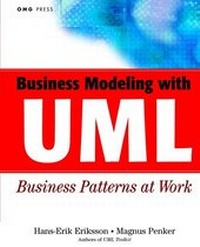
Business Modelling with UML
Business Patterns at Work
Published on 22. February 2000
Book
Paperback/Softback
XX, 460 pages
978-0-471-29551-8 (ISBN)
Unfortunately, price unknown
Article is exhausted; no reprint
Description
"An excellent hands-on book for practitioners eager to document the internal structure and everyday workings of business processes. This clear and practical book belongs on the shelf of everyone dedicated to mapping, maintaining, and streamlining business processes." -Richard Mark Soley, Phd, Chairman and CEO, OMG
"Eriksson and Penker have not just written another patterns book; this is a significant contribution to the key field of business-IT alignment. While capturing profound academic insights, what makes the book so refreshing from a practitioner's viewpoint is the richness of accessible, down-to-earth examples and its pragmatic, unpretentious style."-Paul allen Principal of CBD Strategies and Architectures, Sterling Software
"UML may have been designed by and for software engineers, but Eriksson and Penker have defined a practical extension to UML for describing business processes. They put this extended UML immediately to use with a gallery of common business patterns that should jump start any BPR effort."-Philippe Krchten, Director of Process Development Rational Software
"This book is a marriage between proven business modeling concepts and the techniques of UML. It provides real-world strategies for developing large-scale, mission-critical business systems in a manner accessible to both software and business professionals."-ScottW. Ambler, Author of Process Patterns
Following up on their bestselling book, UML Toolkit, Hans-Erik Eriksson and Magnus Penker now provide expert guidance on how to use UML to model your business systems. In this informative book, key business modeling concepts are presented, including how to define Business Rules with UML's Object Constraint Language (OCL) and how to use business models with use cases. The authors then provide 26 valuable Business Patterns along with an e-business case study that utilizes the techniques and patterns discussed in the book.
Visit our Web site at www.wiley.com/compbooks/
UML (Unified Modeling Language) ist ein leistungsfähiges Tool für die Entwurfsplanung von objektorientierten Computersystemen. Mit seiner Hilfe kann der Zeitaufwand für die Software-Entwicklung enorm reduziert werden. Entsprechend groß ist daher nicht nur die Nachfrage nach UML für firmeninterne Systementwicklung sondern auch nach praktischer Anleitung für den richtigen Einsatz von UML. Dies ist der Nachfolgeband des sehr erfolgreichen Titels "UML Toolkit" von Eriksson und Penker. Er konzentriert sich auf die brandaktuellen komponenten-orientierten Konzepte und erklärt, wie man OCL (Object Constraint Language) von UML für Business Rules und Business Views einsetzt. Dokumentiert sind 27 hilfreiche Business Patterns. (cat06/99)
"Eriksson and Penker have not just written another patterns book; this is a significant contribution to the key field of business-IT alignment. While capturing profound academic insights, what makes the book so refreshing from a practitioner's viewpoint is the richness of accessible, down-to-earth examples and its pragmatic, unpretentious style."-Paul allen Principal of CBD Strategies and Architectures, Sterling Software
"UML may have been designed by and for software engineers, but Eriksson and Penker have defined a practical extension to UML for describing business processes. They put this extended UML immediately to use with a gallery of common business patterns that should jump start any BPR effort."-Philippe Krchten, Director of Process Development Rational Software
"This book is a marriage between proven business modeling concepts and the techniques of UML. It provides real-world strategies for developing large-scale, mission-critical business systems in a manner accessible to both software and business professionals."-ScottW. Ambler, Author of Process Patterns
Following up on their bestselling book, UML Toolkit, Hans-Erik Eriksson and Magnus Penker now provide expert guidance on how to use UML to model your business systems. In this informative book, key business modeling concepts are presented, including how to define Business Rules with UML's Object Constraint Language (OCL) and how to use business models with use cases. The authors then provide 26 valuable Business Patterns along with an e-business case study that utilizes the techniques and patterns discussed in the book.
Visit our Web site at www.wiley.com/compbooks/
UML (Unified Modeling Language) ist ein leistungsfähiges Tool für die Entwurfsplanung von objektorientierten Computersystemen. Mit seiner Hilfe kann der Zeitaufwand für die Software-Entwicklung enorm reduziert werden. Entsprechend groß ist daher nicht nur die Nachfrage nach UML für firmeninterne Systementwicklung sondern auch nach praktischer Anleitung für den richtigen Einsatz von UML. Dies ist der Nachfolgeband des sehr erfolgreichen Titels "UML Toolkit" von Eriksson und Penker. Er konzentriert sich auf die brandaktuellen komponenten-orientierten Konzepte und erklärt, wie man OCL (Object Constraint Language) von UML für Business Rules und Business Views einsetzt. Dokumentiert sind 27 hilfreiche Business Patterns. (cat06/99)
Reviews / Votes
"...excellent value for money." (Computer Bulletin, September 2000)More details
Product info
Paperback
Series
Edition
1. Auflage
Language
English
Place of publication
New York
United States
Target group
College/higher education
Professional and scholarly
Dimensions
Height: 23.5 cm
Width: 19.3 cm
Thickness: 2.6 cm
Weight
822 gr
ISBN-13
978-0-471-29551-8 (9780471295518)
Schweitzer Classification
Persons
HANS-ERIK ERIKSSON (Sweden) is the founder and Chairman of Open Training, a company that specializes in advanced online learning and e-training solutions. He is a skilled trainer with more than ten years' experience in object technology.
MAGNUS PENKER (Sweden) is the CEO of Open Training and a former senior management consultant with over seven years of training experience in process and object-oriented modeling.
MAGNUS PENKER (Sweden) is the CEO of Open Training and a former senior management consultant with over seven years of training experience in process and object-oriented modeling.
Content
Business Modeling.
UML Primer.
Modeling the Business Architecture.
Business Views.
Business Rules.
Business Patterns.
Resource and Rule Patterns.
Goal Patterns.
Process Patterns.
From Business Architecture to Software Architecture.
A Business Model Example.
Appendices.
Glossary.
References.
Index.
UML Primer.
Modeling the Business Architecture.
Business Views.
Business Rules.
Business Patterns.
Resource and Rule Patterns.
Goal Patterns.
Process Patterns.
From Business Architecture to Software Architecture.
A Business Model Example.
Appendices.
Glossary.
References.
Index.