

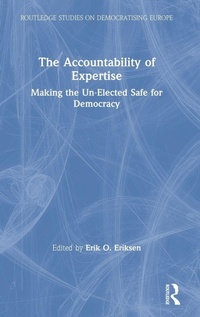
The Accountability of Expertise
Making the Un-Elected Safe for Democracy
1st Edition
Published on 27. July 2021
Book
Hardback
202 pages
978-1-032-00762-5 (ISBN)
Description
Based on in-depth studies of the relationship between expertise and democracy in Europe, this book presents a new approach to how the un-elected can be made safe for democracy. It addresses the challenge of reconciling modern governments' need for knowledge with the demand for democratic legitimacy.
Knowledge-based decision-making is indispensable to modern democracies. This book establishes a public reason model of legitimacy and clarifies the conditions under which unelected bodies can be deemed legitimate as they are called upon to handle pandemics, financial crises, climate change and migration flows. Expert bodies are seeking neither re-election nor popularity, they can speak truth to power as well as to the citizenry at large. They are unelected, yet they wield power. How could they possibly be legitimate?
This book is of key interest to scholars and students of democracy, governance, and more broadly to political and administrative science as well as the Science Technology Studies (STS).
Knowledge-based decision-making is indispensable to modern democracies. This book establishes a public reason model of legitimacy and clarifies the conditions under which unelected bodies can be deemed legitimate as they are called upon to handle pandemics, financial crises, climate change and migration flows. Expert bodies are seeking neither re-election nor popularity, they can speak truth to power as well as to the citizenry at large. They are unelected, yet they wield power. How could they possibly be legitimate?
This book is of key interest to scholars and students of democracy, governance, and more broadly to political and administrative science as well as the Science Technology Studies (STS).
Reviews / Votes
"Is there a 'legitimacy basis for the unelected'? Yes, say Erik O. Eriksen and the specialist authors in this must-read volume. In an age of scepticism about knowledge, we are reminded of the vital importance of 'public reason' as a basis for informed decision-making. We know that we cannot live without experts, but we also know we must legitimate expertise. This volume unlocks this conundrum, reinvigorating existing legal and institutional debates by re-asserting the political-philosophical foundations for legitimate action."Michelle Everson, Birkbeck College, University of London, UK.
"Experts and expertise are under attack. They are needed but lost their aura of impartiality. This book offers a democratic understanding of experts by building on the reasons-giving requirement. Erik O. Eriksen, a master of the intersection between empirical and normative analysis, has gathered a set of intriguing contributions by excellent scholars. The result is a timely contribution to one of the most challenging issues for our democracies."
Michael Zuern, Berlin Social Science Center (WZB), Germany.
More details
Series
Language
English
Place of publication
London
United Kingdom
Publishing group
Taylor & Francis Ltd
Target group
College/higher education
Professional and scholarly
Illustrations
1 s/w Abbildung, 1 s/w Zeichnung, 6 s/w Tabellen
6 Tables, black and white; 1 Line drawings, black and white; 1 Illustrations, black and white
Dimensions
Height: 240 mm
Width: 161 mm
Thickness: 16 mm
Weight
496 gr
ISBN-13
978-1-032-00762-5 (9781032007625)
Copyright in bibliographic data and cover images is held by Nielsen Book Services Limited or by the publishers or by their respective licensors: all rights reserved.
Schweitzer Classification
Other editions
Additional editions

Book
07/2021
1st Edition
Routledge
€60.90
Shipment within 10-20 days
E-Book
07/2021
1st Edition
Routledge
€53.99
Available for download
E-Book
07/2021
1st Edition
Routledge
€53.99
Available for download
Person
Erik O. Eriksen is Professor of Political Science and former director of ARENA, Centre for European Studies, University of Oslo, Norway.
Content
1. Introduction: Making the un-elected safe for democracy 2. Strategies for Repairing legitimacy deficits 3. Reasoned Administration: The European Union, the United States, and the project of democratic governance 4. Power, Money, Knowledge and the European Central Bank 5. Reputational Threats and Democratic Responsiveness of Regulatory Agencies 6. Accountability and Inter-institutional Respect: The case of independent regulatory agencies 7. Accountability beyond Control: How can parliamentary hearings connect the elected and the unelected? 8. Expertise and the General will in Democratic Republicanism 9. Values in Expert Reasoning: A pragmatic approach 10. Experts: From technocrats to representatives