

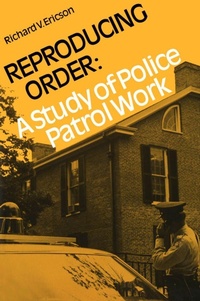
Reproducing Order
A Study of Police Patrol Work
2nd Edition
Will be published approx. on 1. March 1982
Book
Paperback/Softback
243 pages
978-0-8020-6475-2 (ISBN)
Description
Professor Ericson and his colleagues followed the work of patrol officers in a large Canadian regional police force. From their direct observations comes a wealth of information, quantitatively assembled and qualitatively discussed, with insights into the nature of policing.
This book reveals that the police are not mere 'referees' of our legal lives, blowing the whistle on our infractions. They are censors of certain types of possibly wrong actions. They are selective in their invocation of criminal law and use the law artfully to restore settings to orderliness.
Ericson emphasizes the routine manner in which the patrol officer intervenes and gains compliance fron the citizenry. He demonstrates that when the criminal process is invoked, the police maintain fundamental control over the court outcome.
Using these findings, he addresses basic questions about the role of police in relation to crime and how it is produced, literally, by the patrol officer. Crime is also seen as the primary basis of police legitimacy, which in turn enables the police to engage in broad surveillance and information-gathering.
The author's conclusions about the nature of policing and his discussion of the implications of proposals for reform of police, will generate better-informed deliberation in political and public decision-making and in the general study of sociological theory.
This book reveals that the police are not mere 'referees' of our legal lives, blowing the whistle on our infractions. They are censors of certain types of possibly wrong actions. They are selective in their invocation of criminal law and use the law artfully to restore settings to orderliness.
Ericson emphasizes the routine manner in which the patrol officer intervenes and gains compliance fron the citizenry. He demonstrates that when the criminal process is invoked, the police maintain fundamental control over the court outcome.
Using these findings, he addresses basic questions about the role of police in relation to crime and how it is produced, literally, by the patrol officer. Crime is also seen as the primary basis of police legitimacy, which in turn enables the police to engage in broad surveillance and information-gathering.
The author's conclusions about the nature of policing and his discussion of the implications of proposals for reform of police, will generate better-informed deliberation in political and public decision-making and in the general study of sociological theory.
More details
Edition
2nd Revised edition
Language
English
Place of publication
Toronto
Canada
Product notice
Paperback (trade)
Dimensions
Height: 235 mm
Width: 157 mm
Thickness: 18 mm
Weight
381 gr
ISBN-13
978-0-8020-6475-2 (9780802064752)
Copyright in bibliographic data and cover images is held by Nielsen Book Services Limited or by the publishers or by their respective licensors: all rights reserved.
Schweitzer Classification
Person
Richard V. Ericson is principal of Green College and a professor of Law and Sociology at the University of British Columbia.