

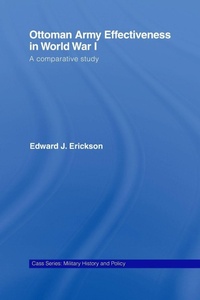
Ottoman Army Effectiveness in World War I
A Comparative Study
1st Edition
Published on 28. April 2014
Book
Paperback/Softback
256 pages
978-0-415-76214-4 (ISBN)
Description
This volume examines how the Ottoman Army was able to evolve and maintain a high level of overall combat effectiveness despite the primitive nature of the Ottoman State during the First World War.
Structured around four case studies, at the operational and tactical level, of campaigns involving the Ottoman Empire and the British Empire: Gallipoli in 1915, Kut in 1916, Third Gaza-Beersheba in 1917, and Megiddo in 1918. For each of these campaigns, particular emphasis is placed on examining specific elements of combat effectiveness and how they affected that particular battle.
The prevalent historiography attributes Ottoman battlefield success primarily to external factors - such as the presence of German generals and staff officers; climate, weather and terrain that adversely affected allied operations; allied bumbling and amateurish operations; and inadequate allied intelligence. By contrast, Edward J. Erickson argues that the Ottoman Army was successful due to internal factors, such as its organizational architecture, a hardened cadre of experienced combat leaders, its ability to organize itself for combat, and its application of the German style of war.
Ottoman Army Effectiveness in World War I will be of great interest to students of the First World War, military history and strategic studies in general.
Structured around four case studies, at the operational and tactical level, of campaigns involving the Ottoman Empire and the British Empire: Gallipoli in 1915, Kut in 1916, Third Gaza-Beersheba in 1917, and Megiddo in 1918. For each of these campaigns, particular emphasis is placed on examining specific elements of combat effectiveness and how they affected that particular battle.
The prevalent historiography attributes Ottoman battlefield success primarily to external factors - such as the presence of German generals and staff officers; climate, weather and terrain that adversely affected allied operations; allied bumbling and amateurish operations; and inadequate allied intelligence. By contrast, Edward J. Erickson argues that the Ottoman Army was successful due to internal factors, such as its organizational architecture, a hardened cadre of experienced combat leaders, its ability to organize itself for combat, and its application of the German style of war.
Ottoman Army Effectiveness in World War I will be of great interest to students of the First World War, military history and strategic studies in general.
Reviews / Votes
'...serves as an introduction to the Ottoman army campaigns in the First World War for an audience unable to use Turkish material.'Kate Fleet, The University of Cambridge, UKMore details
Series
Language
English
Place of publication
London
United Kingdom
Publishing group
Taylor & Francis Ltd
Target group
College/higher education
Professional and scholarly
Illustrations
4 s/w Abbildungen, 12 s/w Zeichnungen, 14 s/w Tabellen
14 Tables, black and white; 12 Line drawings, black and white; 4 Illustrations, black and white
Dimensions
Height: 234 mm
Width: 156 mm
Thickness: 14 mm
Weight
395 gr
ISBN-13
978-0-415-76214-4 (9780415762144)
Copyright in bibliographic data and cover images is held by Nielsen Book Services Limited or by the publishers or by their respective licensors: all rights reserved.
Schweitzer Classification
Other editions
Additional editions
E-Book
02/2007
Routledge
€77.99
Available for download
E-Book
02/2007
Routledge
€77.99
Available for download
Book
02/2007
1st Edition
Routledge
€230.90
Shipment within 15-20 days
Person
Lt. Col. Edward J. Erickson, US Army (retired) has a Ph.D. from the University of Leeds. He is the author of three books and numerous articles on the Ottoman Army during the early twentieth century.
Content
Introduction1. From the Ashes of Disaster2. Gallipoli - 19153. Kut Al Amara - 19164. Gaza-Beersheba - 19175. Meggido - 19186. The Strength of an Army.Appendices.Selected Bibliography.Index