

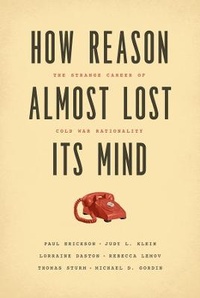
How Reason Almost Lost Its Mind
The Strange Career of Cold War Rationality
Published on 22. November 2013
Book
Hardback
272 pages
978-0-226-04663-1 (ISBN)
Description
In the United States at the height of the Cold War, roughly between the end of World War II and the early 1980s, a new project of redefining rationality commanded the attention of sharp minds, powerful politicians, wealthy foundations, and top military brass. Its home was the human sciences - psychology, sociology, political science, and economics, among others - and its participants enlisted in an intellectual campaign to figure out what rationality should mean and how it could be deployed. How Reason Almost Lost Its Mind brings to life the people - Herbert Simon, Oskar Morgenstern, Herman Kahn, Anatol Rapoport, Thomas Schelling, and many others - and places, including the RAND Corporation, the Center for Advanced Study in the Behavioral Sciences, the Cowles Commission for Research and Economics, and the Council on Foreign Relations, that played a key role in putting forth a "Cold War rationality." Decision makers harnessed this picture of rationality - optimizing, formal, algorithmic, and mechanical - in their quest to understand phenomena as diverse as economic transactions, biological evolution, political elections, international relations, and military strategy.
The authors chronicle and illuminate what it meant to be rational in the age of nuclear brinkmanship.
The authors chronicle and illuminate what it meant to be rational in the age of nuclear brinkmanship.
Reviews / Votes
"This is an important book, one that should be read not just by historians of science but by anyone interested in the unique intellectual culture of Cold War America." (Hunter Heyck, University of Oklahoma)"More details
Language
English
Place of publication
Chicago
United States
Publishing group
The University of Chicago Press
Dimensions
Height: 24 mm
Width: 17 mm
Thickness: 2 mm
Weight
482 gr
ISBN-13
978-0-226-04663-1 (9780226046631)
Copyright in bibliographic data and cover images is held by Nielsen Book Services Limited or by the publishers or by their respective licensors: all rights reserved.
Schweitzer Classification
Other editions
Additional editions
Paul Erickson | Judy L. Klein | Lorraine Daston
How Reason Almost Lost Its Mind
The Strange Career of Cold War Rationality
E-Book
12/2022
University of Chicago Press
€23.53
Available for download
Persons
Paul Erickson is assistant professor of history and science in society at Wesleyan University. Judy L. Klein is professor of economics at Mary Baldwin College. Lorraine Daston is director of the Max Planck Institute for the History of Science and visiting professor in the Committee on Social Thought at the University of Chicago. Rebecca Lemov is associate professor of the history of science at Harvard University. Thomas Sturm is a Ramon y Cajal Research Professor in the Department of Philosophy at the Autonomous University of Barcelona. Michael D. Gordin is professor of the history of science at Princeton University.