

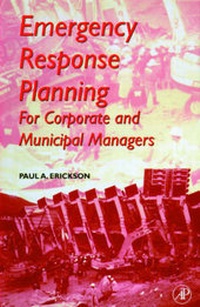
Emergency Response Planning
For Corporate and Municipal Managers
Published on 12. January 1999
Book
Hardback
564 pages
978-0-12-241540-1 (ISBN)
Description
Emergencies wreak havoc on businesses and governments on a daily basis. Whether it is a hurricane pounding a coastal community, a terrorist attack on a company's headquarters, or a hazardous chemical spill at a local school, the results can be loss of life, health, and property. How can you prevent or reduce the effects of such occurrences? By planning ahead. "Emergency Response Planning" is designed to help corporate and municipal managers quickly understand their roles in proactive and reactive emergency management. Author Paul Erickson shows how to develop partnerships with federal, state, and local government agencies, as well as community groups in order to prevent, prepare for, and respond to natural disasters and manmade emergencies. "Emergency Response Planning" provides essential information to help you comply with government regulations, design an emergency response plan, train personnel, use the proper safety equipment, safeguard information systems, and resume normal operations after an emergency as quickly as possible.
It will also help consultants design emergency response plans for their clients, and provide practical information for students studying business continuity and emergency issues. It is an important resource for: corporate and municipal managers involved in emergency management; organizational safety committee members; Industrial health and safety consultants and their clients; graduate and undergraduate students studying emergency response issues. It outlines both proactive and reactive strategies to reduce risk to human life, health, and property; describes how to form effective partnerships with government agencies and community support resources; defines the roles of corporate and municipal managers, planning team members, and response personnel; explains regulations and guidelines from key agencies including OSHA, EPA, FEMA, CDC, US Fire Administration, and more; and, makes information easy to understand with dozens of tables, illustrations, and appendices.
It will also help consultants design emergency response plans for their clients, and provide practical information for students studying business continuity and emergency issues. It is an important resource for: corporate and municipal managers involved in emergency management; organizational safety committee members; Industrial health and safety consultants and their clients; graduate and undergraduate students studying emergency response issues. It outlines both proactive and reactive strategies to reduce risk to human life, health, and property; describes how to form effective partnerships with government agencies and community support resources; defines the roles of corporate and municipal managers, planning team members, and response personnel; explains regulations and guidelines from key agencies including OSHA, EPA, FEMA, CDC, US Fire Administration, and more; and, makes information easy to understand with dozens of tables, illustrations, and appendices.
More details
Edition
1986. Corr. 5th Printing ed.
Language
English
Place of publication
San Diego
United States
Publishing group
Elsevier Science Publishing Co Inc
Target group
College/higher education
Illustrations
100 figures, 54 tables
Dimensions
Height: 229 mm
Width: 152 mm
Weight
935 gr
ISBN-13
978-0-12-241540-1 (9780122415401)
Copyright in bibliographic data and cover images is held by Nielsen Book Services Limited or by the publishers or by their respective licensors: all rights reserved.
Schweitzer Classification
Other editions
New editions
Paul A. Erickson
Emergency Response Planning for Corporate and Municipal Managers
Book
04/2006
2nd Edition
Butterworth-Heinemann
€86.65
Shipment within 15-20 days
Additional editions
E-Book
01/1999
Academic Press
€81.95
Available for download
Content
Scope of Emergency Response. Elements of Holistic Planning and Management. The Emergency Response Plan. Command. Physical and Chemical Hazards. Biohazards. Medical Surveillance. Personal Protective Clothing and Equipment. Personnel Training. Hazard and Risk Reduction Strategies. Decontamination. Data and Information Management. Monitoring Strategies and Devices. Terrorism. Appendices: Glossary. FEMA Office Addresses. Regional and Area OSHA Offices. States with Approved Occupational Safety and Health Plans. OSHA Consultation Directory. State Emergency Response Committees. FEMA Emergency Management Guide for Business and Industry. OSHA Training Curriculum Guidelines 29 CFR 1910.120 (Hazardous Waste Operations and Emergency Response). Terrorism Incident Annex to the Federal Response Plan. Presidential Decision Directive 39 (Unclassified). National Fire Academy and Emergency Management Institute Courses Related to Consequence Management. Emergency Procedures for Employees with Disabilities in Office Occupancies (U.S. Fire Administration: June 1995). How to Prepare for Workplace Emergencies (U.S. Department of Labor OSHA (1995) Revised.)