

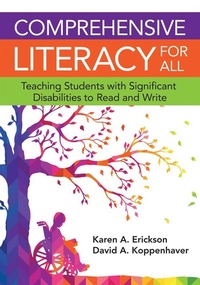
Comprehensive Literacy for All
Teaching Students with Significant Disabilities to Read and Write
Published on 30. December 2019
Book
Paperback/Softback
272 pages
978-1-59857-657-3 (ISBN)
Description
Grounded in the belief that all students can learn to read and write print, this book is a thorough yet practical guide for teaching students with significant disabilities. It explains how to provide comprehensive literacy instruction addressing these students' needs, whether they are emergent readers and writers or students acquiring conventional literacy skills. General and special educators, speech-language pathologists, and other professionals will find concise research synopses and theoretical frameworks, practical lesson formats, guidance on incorporating assessment and using assistive technology, and more.
More details
Language
English
Place of publication
Baltimore
United States
Target group
Primary & secondary/elementary & high school
Product notice
Paperback (trade)
Unsewn / adhesive bound
Dimensions
Height: 254 mm
Width: 179 mm
Thickness: 20 mm
Weight
459 gr
ISBN-13
978-1-59857-657-3 (9781598576573)
Copyright in bibliographic data and cover images is held by Nielsen Book Services Limited or by the publishers or by their respective licensors: all rights reserved.
Schweitzer Classification
Persons
David A. Koppenhaver, Ph.D., is Professor in the Reading Education and Special Education Department at Appalachian State University. His research focuses on literacy in individuals with significant disabilities, including those with complex communication needs. He and David Yoder cofounded the Center for Literacy and Disability Studies at the University of North Carolina at Chapel Hill in 1990.
Karen A. Erickson, Ph.D., is Yoder Distinguished Professor and Director of the Center for Literacy and Disability Studies at the University of North Carolina at Chapel Hill. A former teacher of children with significant disabilities, Dr. Erickson's current research addresses literacy and communication assessment and intervention for students with a range of disabilities, including significant disabilities. Dr. Erickson is codeveloper of the Tar Heel Reader online library of accessible books for beginning readers as well as several other assistive, learning, and communication technologies.
Karen A. Erickson, Ph.D., is Yoder Distinguished Professor and Director of the Center for Literacy and Disability Studies at the University of North Carolina at Chapel Hill. A former teacher of children with significant disabilities, Dr. Erickson's current research addresses literacy and communication assessment and intervention for students with a range of disabilities, including significant disabilities. Dr. Erickson is codeveloper of the Tar Heel Reader online library of accessible books for beginning readers as well as several other assistive, learning, and communication technologies.
Content
About the Downloads
About the Authors
Foreword - David E. Yoder
Introduction
Acknowledgments
Section I Core Understandings
Chapter 1 All Children Can Learn to Read and Write: A Theoretical Rationale
Chapter 2 Establishing the Environment for Successful Literacy Learning
Section II Building a Foundation
Chapter 3 Alphabet Knowledge and Phonological Awareness
Chapter 4 Emergent Reading
Chapter 5 Emergent Writing
Section III Learning to Read and Write
Chapter 6 Comprehensive Literacy Instruction: A Research-Based Framework
Chapter 7 Reading Comprehension and Vocabulary Instruction
Chapter 8 Self-Directed Reading: Supporting Motivation and Fluency
Chapter 9 Writing
Chapter 10 Decoding, Word Identification, and Spelling
Section IV Implementation
Chapter 11 Using Assistive Technology Effectively to Support Literacy
Chapter 12 Organizing and Delivering Effective Instruction
References
Index
About the Authors
Foreword - David E. Yoder
Introduction
Acknowledgments
Section I Core Understandings
Chapter 1 All Children Can Learn to Read and Write: A Theoretical Rationale
Chapter 2 Establishing the Environment for Successful Literacy Learning
Section II Building a Foundation
Chapter 3 Alphabet Knowledge and Phonological Awareness
Chapter 4 Emergent Reading
Chapter 5 Emergent Writing
Section III Learning to Read and Write
Chapter 6 Comprehensive Literacy Instruction: A Research-Based Framework
Chapter 7 Reading Comprehension and Vocabulary Instruction
Chapter 8 Self-Directed Reading: Supporting Motivation and Fluency
Chapter 9 Writing
Chapter 10 Decoding, Word Identification, and Spelling
Section IV Implementation
Chapter 11 Using Assistive Technology Effectively to Support Literacy
Chapter 12 Organizing and Delivering Effective Instruction
References
Index