

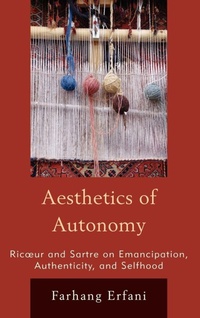
The Aesthetics of Autonomy
Ricoeur and Sartre on Emancipation, Authenticity, and Selfhood
Published on 22. February 2011
Book
Hardback
166 pages
978-0-7391-1258-8 (ISBN)
Description
The Aesthetics of Autonomy: Ricoeur and Sartre on Emancipation, Authenticity, and Selfhood argues that, despite their differences, Sartre and Ricoeur have a similar goal. While they are both anti-essentialists, they nevertheless advocate for the notions of selfhood and autonomy. Autonomy, for them, is the end result of an aesthetic path. An identity, at the individual or collective level, is created by weaving together contingent threads of the given. In other words, identity is a narrative construct. The first two chapters focus on the respective methods of Sartre and Ricoeur. Despite their different emphases, Farhang Erfani argues that they have a similar dialectical method, between the situation and our ability to surpass it for Sartre, and between sedimentation and innovation for Ricoeur. The third chapter brings them together and shows how they can complement each other in building a narrative identity at the individual level; Ricoeur is helpful in appreciating Sartrean notions of bad faith and authenticity. The fourth and final chapter turns to collective identity; Erfani argues that Ricoeur's notions of ideology and utopia are better complemented with Sartrean political ethics. Erfani advocates for a Sartrean model of "Dark Utopianism" that overcomes the limits of Ricoeur's political philosophy. Reading Sartre and Ricoeur together provides for a balanced approach to the question of autonomy that at once pays due attention to the weight of the situation and the past, while opening up the space for change, innovation, and progress. The conclusion, accordingly, applies this thesis to the question of globalization.
Both Sartre and Ricoeur scholars will be eager to explore and debate the original synthesis presented in The Aesthetics of Autonomy. It also makes contributions to hermeneutics, post-War French philosophy, and philosophy of religion. Finally, given its emphases on politics and aesthetics, the book also places itself within arguments of political theory and literary theory.
Both Sartre and Ricoeur scholars will be eager to explore and debate the original synthesis presented in The Aesthetics of Autonomy. It also makes contributions to hermeneutics, post-War French philosophy, and philosophy of religion. Finally, given its emphases on politics and aesthetics, the book also places itself within arguments of political theory and literary theory.
Reviews / Votes
Dr. Erfani's book on Sartre and Ricoeur is a welcome re-reading, together, of two relatively neglected thinkers, with a view of appropriating what is most valuable in each for understanding the challenges posed by globalization to the newly 'fragile' subjects of an increasingly complex, globalized world. It will appeal to those individuals who are nevertheless interested in creatively rescuing a sense of autonomy and selfhood-an aesthetic path to an autonomous self-from oblivion at a time when heteronomy appears to be increasingly the rule in various domains. With insight and humour, Erfani demonstrates that these thinkers' conceptions of imagination and creativity, together with a sensitivity for the constitutive role of narrative for individual subjects, can revitalize our own floundering attempts to rise above the restrictions of the nation state while still clinging to the protection it supposedly affords one from global, multi-national corporate power. -- Bert Olivier, Nelson Mandela Metropolitan UniversityMore details
Language
English
Place of publication
United States
Publishing group
Bloomsbury Publishing Plc
Target group
College/higher education
Dimensions
Height: 235 mm
Width: 157 mm
Thickness: 14 mm
Weight
406 gr
ISBN-13
978-0-7391-1258-8 (9780739112588)
Copyright in bibliographic data and cover images is held by Nielsen Book Services Limited or by the publishers or by their respective licensors: all rights reserved.
Schweitzer Classification
Person
Farhang Erfani is assistant professor of philosophy at American University and research associate at Nelson Mandela Metropolitan University.
Content
Introduction
Chapter 1. Can the Revolutionary Agent Ski? On Sartre's Methodology
Chapter 2. Dialectics of Sedimentation and Innovation: On Ricoeur's Methodology
Chapter 3. Giving Style to One's Life: Existentialist Narrative Ethics
Chapter 4. From Ideology to Dark Utopia
Conclusion: "Imagine There's No Countries"
Chapter 1. Can the Revolutionary Agent Ski? On Sartre's Methodology
Chapter 2. Dialectics of Sedimentation and Innovation: On Ricoeur's Methodology
Chapter 3. Giving Style to One's Life: Existentialist Narrative Ethics
Chapter 4. From Ideology to Dark Utopia
Conclusion: "Imagine There's No Countries"