

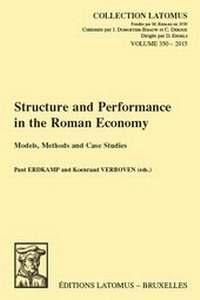
Structure and Performance in the Roman Economy
Models, Methods and Case Studies
1st Edition
Published on 5. October 2015
Book
Paperback/Softback
238 pages
978-90-429-3280-7 (ISBN)
Unfortunately, price unknown
Available (delivery time upon request)
Not available
Description
History is a reality that can be observed only through the traces it has
left. Some are words and images (on parchment, papyrus, stone or any
other bearer) conveying us the emotions and reflections of people in the
past. Others are the scars and leftovers of human lives and actions,
scattered in the landscape, buried or sunk under water. Historians and
archaeologists are experts in restoring the damage done to a body of
evidence by time or human manipulation. We are trained empiricists, wont
to look down and think bottom-up. Economic history, however, requires us
to do more: we need to look up. Economics is about explaining patterns
in human interaction by detecting its causes and effects. However good
our restored data are, the patterns they reveal will always be too
fragmented and have too many loose ends to unveil reality. Economic
history is always an act of imagination. The challenge is to ensure that
it does not become an insubstantial pageant. Theories, models and
comparative history help us to do that. They are explanatory frames and
tools, showing the consequences of our assumptions and suggesting
solutions to fill in the gaps. They do not diminish the need for
empirical research methods. The output of any model depends on the
reliability of its input data. This book discusses theories and models
we believe are useful in economic history, but it also invites the
reader to look at methods (both new and traditional) to ensure that
input data are reliable, and offers case studies showing what can be
done.
left. Some are words and images (on parchment, papyrus, stone or any
other bearer) conveying us the emotions and reflections of people in the
past. Others are the scars and leftovers of human lives and actions,
scattered in the landscape, buried or sunk under water. Historians and
archaeologists are experts in restoring the damage done to a body of
evidence by time or human manipulation. We are trained empiricists, wont
to look down and think bottom-up. Economic history, however, requires us
to do more: we need to look up. Economics is about explaining patterns
in human interaction by detecting its causes and effects. However good
our restored data are, the patterns they reveal will always be too
fragmented and have too many loose ends to unveil reality. Economic
history is always an act of imagination. The challenge is to ensure that
it does not become an insubstantial pageant. Theories, models and
comparative history help us to do that. They are explanatory frames and
tools, showing the consequences of our assumptions and suggesting
solutions to fill in the gaps. They do not diminish the need for
empirical research methods. The output of any model depends on the
reliability of its input data. This book discusses theories and models
we believe are useful in economic history, but it also invites the
reader to look at methods (both new and traditional) to ensure that
input data are reliable, and offers case studies showing what can be
done.
More details
Series
Language
English
Place of publication
Leuven
Belgium
Target group
Professional and scholarly
Weight
420 gr
ISBN-13
978-90-429-3280-7 (9789042932807)
Copyright in bibliographic data and cover images is held by Nielsen Book Services Limited or by the publishers or by their respective licensors: all rights reserved.
Schweitzer Classification