

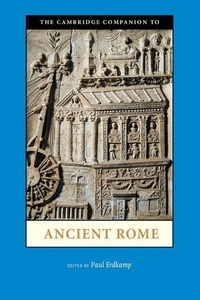
The Cambridge Companion to Ancient Rome
Published on 29. August 2013
Book
Paperback/Softback
646 pages
978-0-521-72078-6 (ISBN)
Description
Rome was the largest city in the ancient world. As the capital of the Roman Empire, it was clearly an exceptional city in terms of size, diversity and complexity. While the Colosseum, imperial palaces and Pantheon are among its most famous features, this volume explores Rome primarily as a city in which many thousands of men and women were born, lived and died. The thirty-one chapters by leading historians, classicists and archaeologists discuss issues ranging from the monuments and the games to the food and water supply, from policing and riots to domestic housing, from death and disease to pagan cults and the impact of Christianity. Richly illustrated, the volume introduces groundbreaking new research against the background of current debates and is designed as a readable survey accessible in particular to undergraduates and non-specialists.
More details
Series
Language
English
Place of publication
Cambridge
United Kingdom
Target group
College/higher education
Professional and scholarly
Product notice
Paperback (trade)
Illustrations
10 Maps; 30 Halftones, unspecified; 9 Line drawings, unspecified
Dimensions
Height: 229 mm
Width: 152 mm
Thickness: 35 mm
Weight
921 gr
ISBN-13
978-0-521-72078-6 (9780521720786)
Copyright in bibliographic data and cover images is held by Nielsen Book Services Limited or by the publishers or by their respective licensors: all rights reserved.
Schweitzer Classification
Other editions
Additional editions
Paul Erdkamp
The Cambridge Companion to Ancient Rome
Book
09/2013
Cambridge University Press
€116.80
Shipment within 15-20 days
Paul Erdkamp
The Cambridge Companion to Ancient Rome
E-Book
08/2013
1st Edition
Cambridge University Press
€32.49
Available for download
Person
Paul Erdkamp is Professor of Ancient History at the Free University of Brussels (VUB). Previously, he was Research Fellow at the University of Leiden. He has published two monographs: Hunger and the Sword. Warfare and Food Supply in Roman Republican Wars (1998) and The Grain Market in the Roman Empire (2005), and is editor of The Roman Army and the Economy (2002), A Companion to the Roman Army (2007) and A Cultural History of Food in Antiquity (2012). His research interests include the ancient economy, army and warfare, ancient historiography, in particular Polybius and Livy, and social and cultural aspects of food in classical antiquity. Professor Erdkamp is currently co-chair of the Roman Society Research Centre, in which various departments of ancient history and archaeology at European universities participate.
Content
Introduction Paul Erdkamp; 1. The emergence of the city Alexandre Grandazzi; Part I. Inhabitants: 2. Population size and social structure Neville Morley; 3. Disease and death Walter Scheidel; 4. Slaves and freedmen Elisabeth Herrmann-Otto; 5. Immigration and cosmopolitanization Claudia Moatti; 6. Marriages, families, households Beryl Rawson; 7. Pack-animals, pets, pests, and other non-human beings Michael MacKinnon; Part II. The Urban Fabric: 8. The urban topography of Rome Elisha Dumser; 9. Housing and domestic architecture Glenn R. Storey; 10. Regions and neighborhoods J. Bert Lott; 11. Monumental Rome Roy D. Miller; 12. (Sub)urban surroundings Robert Witcher; Part III. Logistical Challenges: 13. The Tiber and river transport Steven L. Tuck; 14. Traffic and land transportation in and near Rome Ray Laurence; 15. The food supply of the capital Paul Erdkamp; 16. Counting bricks and stacking wood: providing the physical fabric Shawn Graham; 17. Water supply, drainage and watermills Christer Bruun; Part IV. Working for a Living: 18. Industries and services Wim Broekaert and Arjan Zuiderhoek; 19. Labour and employment Cameron Hawkins; 20. Professional associations Jinyu Liu; 21. Sex and the city Thomas A. J. McGinn; Part V. Rulers and the Ruled: 22. Civic rituals and political spaces in Republican and Imperial Rome Adam Ziolkowski; 23. Policing and security Benjamin Kelly; 24. Riots Gregory S. Aldrete; 25. 'Romans, play on!': city of the games Nicholas Purcell; Part VI. Beyond This World: 26. The urban sacred landscape Andreas Bendlin; 27. Structuring time: festivals, holidays and the calendar Michele R. Salzman; 28. Cemeteries and catacombs Leonard V. Rutgers; 29. What difference did Christianity make? A. D. Lee; Epilogue: 30. The city in ruin: text, image, and imagination Catharine Edwards; 31. Roma aeterna Ingrid Rowland.