

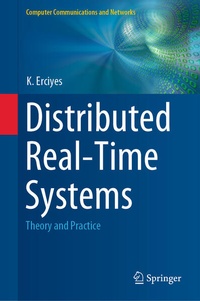
Distributed Real-Time Systems
Description
This classroom-tested textbook describes the design and implementation of software for distributed real-time systems, using a bottom-up approach. The text addresses common challenges faced in software projects involving real-time systems, and presents a novel method for simply and effectively performing all of the software engineering steps. Each chapter opens with a discussion of the core concepts, together with a review of the relevant methods and available software. This is then followed with a description of the implementation of the concepts in a sample kernel, complete with executable code.
Topics and features: introduces the fundamentals of real-time systems, including real-time architecture and distributed real-time systems; presents a focus on the real-time operating system, covering the concepts of task, memory, and input/output management; provides a detailed step-by-step construction of a real-time operating system kernel, which is then used to test various higher level implementations; describes periodic and aperiodic scheduling, resource management, and distributed scheduling; reviews the process of application design from high-level design methods to low-level details of design and implementation; surveys real-time programming languages and fault tolerance techniques; includes end-of-chapter review questions, extensive C code, numerous examples, and a case study implementing the methods in real-world applications; supplies additional material at an associated website.Requiring only a basic background in computer architecture and operating systems, this practically-oriented work is an invaluable study aid for senior undergraduate and graduate-level students of electrical and computer engineering, and computer science. The text will also serve as a useful general reference for researchers interested in real-time systems.
Reviews / Votes
"This textbook summarizes contemporary knowledge and paradigms of real-time systems in a monographic way. It fits an undergraduate-level course since it starts with basic hardware and low-level real-time system characteristics. ... The structure of the textbook and the building up of the chapter show readers how the theoretical background and practice can be handled in a unified framework." (Balint Molnar, Computing Reviews, June 18, 2021)"This textbook summarizes contemporary knowledge and paradigms of real-time systems in a monographic way. It fits an undergraduate-level course since it starts with basic hardware and low-level real-time system characteristics. ... The structure of the textbook and the building up of the chapter show readers how the theoretical background and practice can be handled in a unified framework." (Balint Molnar, Computing Reviews, June 18, 2021)
More details
Other editions
Additional editions
Person
Content
Introduction to Real-Time Systems
The Hardware
Distributed Real-Time Systems
Part II: System Software
Real-Time Operating Systems
Design of an Experimental Distributed Real-Time Kernel
Distributed Real-Time Operating Systems and the Middleware
Part III: Scheduling and Resource Sharing
Uniprocessor Independent Task Scheduling
Uniprocessor Dependent Task Scheduling
Multiprocessor and Distributed Real-Time Scheduling
Part IV: Application Design
Software Engineering of Real-Time Systems
Real-Time Programming Languages
Fault Tolerance
Case Study: Environment Monitoring by a Wireless Sensor Network
Appendix A: Pseudocode Conventions
Appendix B: Lower Kernel Functions