

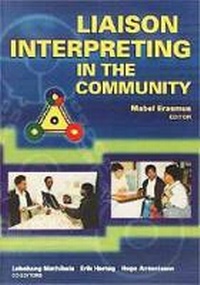
Liaison interpreting in the community
Published on 1. January 1999
Book
Paperback/Softback
314 pages
978-0-627-02448-1 (ISBN)
Description
South Africans have only recently added liaison interpreting to the range of skills developed by language practitioners, thereby broadening the scope of the language professions - a step without which the language rights bestowed on all South African citizens by the new Constitution would have remained only an empty promise. Liaison interpreters, cultural mediators, or community interpreters, as they are generally known, form the link between interlocutors lacking a common language. Unlike the existing literature which focuses on this crucial activity in developed countries, this volume of contributions on liaison interpreting and translation focuses on a developing country - South Africa. Several local and international experts address a wide range of issues relating to the broader topics of contextualisation, practice, training and professionalism. Examples are taken from various fields - health care, the public service, social work, community life, psychiatry and psychology - and various language contexts - including sign language - are covered.
This stimulating, inclusive book provides invaluable information for all language practitioners - trainers and students, language planners and managers, public service and other officials, service providers who work with interpreters, and those involved in promoting language rights, specifically functional multilingualism.
South Africans have only recently added liaison interpreting to the range of skills developed by language practitioners, thereby broadening the scope of the language professions - a step without which the language rights bestowed on all South African citizens by the new Constitution would have remained only an empty promise. Liaison interpreters, cultural mediators, or community interpreters, as they are generally known, form the link between interlocutors lacking a common language. Unlike the existing literature which focuses on this crucial activity in developed countries, this volume of contributions on liaison interpreting and translation focuses on a developing country - South Africa. Several local and international experts address a wide range of issues relating to the broader topics of contextualisation, practice, training and professionalism. Examples are taken from various fields - health care, the public service, social work, community life, psychiatry and psychology - and various language contexts - including sign language - are covered.
This stimulating, inclusive book provides invaluable information for all language practitioners - trainers and students, language planners and managers, public service and other officials, service providers who work with interpreters, and those involved in promoting language rights, specifically functional multilingualism.
This stimulating, inclusive book provides invaluable information for all language practitioners - trainers and students, language planners and managers, public service and other officials, service providers who work with interpreters, and those involved in promoting language rights, specifically functional multilingualism.
South Africans have only recently added liaison interpreting to the range of skills developed by language practitioners, thereby broadening the scope of the language professions - a step without which the language rights bestowed on all South African citizens by the new Constitution would have remained only an empty promise. Liaison interpreters, cultural mediators, or community interpreters, as they are generally known, form the link between interlocutors lacking a common language. Unlike the existing literature which focuses on this crucial activity in developed countries, this volume of contributions on liaison interpreting and translation focuses on a developing country - South Africa. Several local and international experts address a wide range of issues relating to the broader topics of contextualisation, practice, training and professionalism. Examples are taken from various fields - health care, the public service, social work, community life, psychiatry and psychology - and various language contexts - including sign language - are covered.
This stimulating, inclusive book provides invaluable information for all language practitioners - trainers and students, language planners and managers, public service and other officials, service providers who work with interpreters, and those involved in promoting language rights, specifically functional multilingualism.
More details
Edition
Reissue
Language
English
Place of publication
Hatfield
South Africa
Target group
Professional and scholarly
College/higher education
Dimensions
Height: 245 mm
Width: 172 mm
Weight
538 gr
ISBN-13
978-0-627-02448-1 (9780627024481)
Copyright in bibliographic data and cover images is held by Nielsen Book Services Limited or by the publishers or by their respective licensors: all rights reserved.
Schweitzer Classification