

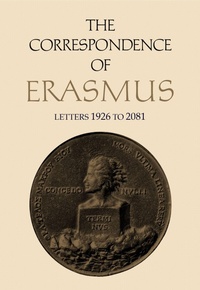
The Correspondence of Erasmus
Letters 1926 to 2081, Volume 14
Published on 9. April 2011
Book
Hardback
624 pages
978-1-4426-4044-3 (ISBN)
Description
The predominant theme of the letters of 1528 is Erasmus' controversies with a variety of critics and opponents. The publication in March of the dialogue Ciceronianus, for example, provoked a huge uproar in France because it included an ironic jest that was considered insulting to the great French humanist Guillaume Bude. More serious were the continuing efforts of conservative Catholics in France (Noel Beda), Italy (Alberto Pio), and Spain (members of the religious orders) to prove not only that Erasmus was a secret Lutheran but also that humanist scholarship was the source of the Lutheran heresy. In response to these charges Erasmus wrote letters and books in which he vigorously defended his orthodoxy and assiduously cultivated the support of his many admirers among the princes and prelates of Europe.
The letters also record Erasmus' growing anxiety over the progress of the Reformation in Basel, which would cause him to leave the city in 1529; his diligent attention to his financial affairs, which had improved in recent years thanks to the assistance of the Antwerp banker, Erasmus Schets; and his progress on the great editions of Augustine and Seneca that would be published in 1529.
Volume 14 of the Collected Works of Erasmus series.
The letters also record Erasmus' growing anxiety over the progress of the Reformation in Basel, which would cause him to leave the city in 1529; his diligent attention to his financial affairs, which had improved in recent years thanks to the assistance of the Antwerp banker, Erasmus Schets; and his progress on the great editions of Augustine and Seneca that would be published in 1529.
Volume 14 of the Collected Works of Erasmus series.
Reviews / Votes
'Anyone who has tried to translate Erasmus's Latin will marvel at the skill and talent displayed here to render it into good idiomatic English... This volume together with volume 13 will certainly satisfy even a gargantuan appetite for Erasmiana in English.' - Mark Crane (Renaissance & Reformation, Summer 2011)More details
Series
Language
English
Place of publication
Toronto
Canada
Target group
College/higher education
Product notice
sewn/stitched
Cloth over boards
With dust jacket
Illustrations
20 halftones; 1 map
Dimensions
Height: 249 mm
Width: 182 mm
Thickness: 39 mm
Weight
1125 gr
ISBN-13
978-1-4426-4044-3 (9781442640443)
Copyright in bibliographic data and cover images is held by Nielsen Book Services Limited or by the publishers or by their respective licensors: all rights reserved.
Schweitzer Classification
Persons
Desiderius Erasmus (c. 1466-1536), a Dutch humanist, Catholic priest, and scholar, was one of the most influential Renaissance figures. A professor of divinity and Greek, Erasmus wrote, taught, and travelled, meeting with Europe's foremost scholars. A prolific author, Erasmus wrote on both ecclesiastic and general human interest subjects.
James M. Estes is professor emeritus of history at Victoria College, University of Toronto.
Charles E. Fantazzi is the Thomas Harriot Distinguished Teaching Professor Emeritus of Classics and Great Books at East Carolina University.
James M. Estes is professor emeritus of history at Victoria College, University of Toronto.
Charles E. Fantazzi is the Thomas Harriot Distinguished Teaching Professor Emeritus of Classics and Great Books at East Carolina University.