

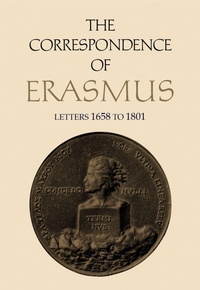
The Correspondence of Erasmus
Letters 1658-1801, Volume 12
Will be published approx. on 10. March 2003
Book
Hardback
500 pages
978-0-8020-4831-8 (ISBN)
Description
The letters in Volume 12 cover Erasmus' correspondence for all of 1526 and roughly the first quarter of 1527. This was a difficult period for Erasmus for various reasons, including two bouts of illness serious enough to cause him to draw up his first will in January 1527, and the fact that the Reformers were gaining more and more influence over religious policy in Basel, where he resided. Tension caused by Erasmus' open opposition to this trend was multiplied by the continuing decline in his relations with Oecolampadius, Pellicanus, and Zwingli, all of them former friends or even collaborators in his scholarly editions. These many distractions slowed but did not stop his continuing biblical, patristic, and classical scholarship.
Fearing that the Lutherans might gain complete control of public discourse on the disputed issue of free will, Erasmus rushed to complete his rebuttal to Luther's De servo arbitrio in March 1526. He also felt deeply aggrieved by the attacks launched against him by conservative Catholics at a time when he was actively engaged in opposing the spread of heresy in Germany and Switzerland. His most redoubtable antagonist was Nodl BTda of the University of Paris, who pressed ahead with his plans for a condemnation of Erasmus by the faculty, which he achieved in December 1527. Erasmus' critics at Louvain were more discreet than BTda; their published works obliquely criticized his publications but did not attack him by name. The letters of 1526-1527 also reflect Erasmus' growing fame in Spain, where not only the Latinate intellectuals but also readers of the new Spanish translations of his spiritual writings and satirical works were attracted to his ideas of spiritual renewal.
CWE 12 also contains translations of his earliest will and selections from correspondence among his Spanish admirers during the years 1522-1527. An important and extremely useful appendix, 'Money, Wages, and Real Incomes in the Age of Erasmus,' by John H. Munro, analyzes the purchasing power of money in the period 1500-1540.
Volume 12 of the Collected Works of Erasmus series.
Fearing that the Lutherans might gain complete control of public discourse on the disputed issue of free will, Erasmus rushed to complete his rebuttal to Luther's De servo arbitrio in March 1526. He also felt deeply aggrieved by the attacks launched against him by conservative Catholics at a time when he was actively engaged in opposing the spread of heresy in Germany and Switzerland. His most redoubtable antagonist was Nodl BTda of the University of Paris, who pressed ahead with his plans for a condemnation of Erasmus by the faculty, which he achieved in December 1527. Erasmus' critics at Louvain were more discreet than BTda; their published works obliquely criticized his publications but did not attack him by name. The letters of 1526-1527 also reflect Erasmus' growing fame in Spain, where not only the Latinate intellectuals but also readers of the new Spanish translations of his spiritual writings and satirical works were attracted to his ideas of spiritual renewal.
CWE 12 also contains translations of his earliest will and selections from correspondence among his Spanish admirers during the years 1522-1527. An important and extremely useful appendix, 'Money, Wages, and Real Incomes in the Age of Erasmus,' by John H. Munro, analyzes the purchasing power of money in the period 1500-1540.
Volume 12 of the Collected Works of Erasmus series.
More details
Series
Language
English
Place of publication
Toronto
Canada
Target group
College/higher education
Product notice
With printed dust jacket
Dimensions
Height: 259 mm
Width: 174 mm
Thickness: 59 mm
Weight
1533 gr
ISBN-13
978-0-8020-4831-8 (9780802048318)
Copyright in bibliographic data and cover images is held by Nielsen Book Services Limited or by the publishers or by their respective licensors: all rights reserved.
Schweitzer Classification
Persons
Desiderius Erasmus (c. 1466-1536), a Dutch humanist, Catholic priest, and scholar, was one of the most influential Renaissance figures. A professor of divinity and Greek, Erasmus wrote, taught, and travelled, meeting with Europe's foremost scholars. A prolific author, Erasmus wrote on both ecclesiastic and general human interest subjects.
Alexander Dalzell is professor emeritus of classics at the University of Toronto (Trinity College).
Charles G. Nauert is Professor Emeritus of History at the University of Missouri-Columbia. His publications have dealt with various aspects of Renaissance humanism, mainly north of the Alps.
Alexander Dalzell is professor emeritus of classics at the University of Toronto (Trinity College).
Charles G. Nauert is Professor Emeritus of History at the University of Missouri-Columbia. His publications have dealt with various aspects of Renaissance humanism, mainly north of the Alps.