

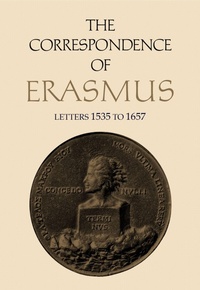
The Correspondence of Erasmus
Letters 1535-1657, Volume 11
Will be published approx. on 7. February 1994
Book
Hardback
476 pages
978-0-8020-0536-6 (ISBN)
Description
The Peasant's War in Germany and his own ill-health combined to keep Erasmus confined to the city of Basel during 1525, but he was still able to maintain an active correspondence spanning all of Europe. In the preceding year, he had published De libero artbitrio/Freedom of the Will, his first open attack on the teachings of Martin Luther. Despite this public defence of Catholic doctrine, Erasmus was continually forced in his correspondence to reply to open or veiled attacks by Catholic critics.
Erasmus directly addressed one of his critics, No+l BTda, of the Paris theological faculty, in the spring of 1525. BTda was preparing analyses of Erasmus' publications that would eventually form the basis for a formal condemnation. Erasmus' correspondence with BTda, intended to head off such a condemnation, continued past 1525 and became increasingly hostile in tone. That same year, Erasmus also followed up reports that an influential Italian humanist, Alberta Pio, Prince of Carpi, was circulating at the papal curia a manuscript accusing Erasmus of being the major source of Luther's errors. Again, he directly addressed his opponent in order to prove his orthodoxy and to urge (in vain) that no such attack be published. In both cases, however, despite his break with Luther and his public and private opposition to the Protestant leader Oecolampadius in Basel, he was unsuccessful in turning aside the hostility of his Catholic critics.
Volume 11 of the Collected Works of Erasmus series.
Erasmus directly addressed one of his critics, No+l BTda, of the Paris theological faculty, in the spring of 1525. BTda was preparing analyses of Erasmus' publications that would eventually form the basis for a formal condemnation. Erasmus' correspondence with BTda, intended to head off such a condemnation, continued past 1525 and became increasingly hostile in tone. That same year, Erasmus also followed up reports that an influential Italian humanist, Alberta Pio, Prince of Carpi, was circulating at the papal curia a manuscript accusing Erasmus of being the major source of Luther's errors. Again, he directly addressed his opponent in order to prove his orthodoxy and to urge (in vain) that no such attack be published. In both cases, however, despite his break with Luther and his public and private opposition to the Protestant leader Oecolampadius in Basel, he was unsuccessful in turning aside the hostility of his Catholic critics.
Volume 11 of the Collected Works of Erasmus series.
More details
Series
Language
English
Place of publication
Toronto
Canada
Target group
College/higher education
Professional and scholarly
Product notice
Cloth over boards
Dimensions
Height: 253 mm
Width: 179 mm
Thickness: 41 mm
Weight
1048 gr
ISBN-13
978-0-8020-0536-6 (9780802005366)
Copyright in bibliographic data and cover images is held by Nielsen Book Services Limited or by the publishers or by their respective licensors: all rights reserved.
Schweitzer Classification
Persons
Desiderius Erasmus (c. 1466-1536), a Dutch humanist, Catholic priest, and scholar, was one of the most influential Renaissance figures. A professor of divinity and Greek, Erasmus wrote, taught, and travelled, meeting with Europe's foremost scholars. A prolific author, Erasmus wrote on both ecclesiastic and general human interest subjects.
Alexander Dalzell is professor emeritus of classics at the University of Toronto (Trinity College).
Charles G. Nauert is Professor Emeritus of History at the University of Missouri-Columbia. His publications have dealt with various aspects of Renaissance humanism, mainly north of the Alps.
Alexander Dalzell is professor emeritus of classics at the University of Toronto (Trinity College).
Charles G. Nauert is Professor Emeritus of History at the University of Missouri-Columbia. His publications have dealt with various aspects of Renaissance humanism, mainly north of the Alps.