

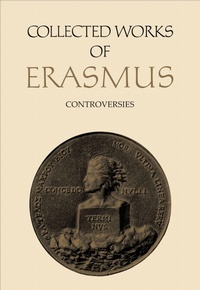
Collected Works of Erasmus
Controversies, Volume 74
Published on 16. January 2023
Book
Hardback
408 pages
978-1-4875-4629-8 (ISBN)
Description
Erasmus' thorough engagement with the New Testament, in particular his revision of the Vulgate translation, aroused much controversy, especially in the orthodox Roman Catholic country of Spain. Erasmus had to fight fierce polemics with several people, including two Spanish scholars, Diego Lopez Zuniga and Sancho Carranza de Miranda, who were both connected to the University of Alcala. This quarrel lasted from 1520 to 1524, with a late response by Erasmus in 1529. The discussion started as a philological one, regarding "correct" Latin, but turned into a dogmatic-theological fight over the issues of whether the New Testament speaks of Christ as God, whether one can apply the term servus (servant) to Christ, and whether the sacramental character of matrimony can be deduced from Ephesians 5:32.
The six texts in this volume are here translated and annotated for the first time. With elucidating notes and an introduction, the volume offers wonderful insight into a fierce and fundamental polemic over the New Testament
The six texts in this volume are here translated and annotated for the first time. With elucidating notes and an introduction, the volume offers wonderful insight into a fierce and fundamental polemic over the New Testament
More details
Series
Language
English
Place of publication
Toronto
Canada
Target group
College/higher education
Professional and scholarly
Product notice
sewn/stitched
Cloth over boards
Dimensions
Height: 254 mm
Width: 180 mm
Thickness: 30 mm
Weight
930 gr
ISBN-13
978-1-4875-4629-8 (9781487546298)
Copyright in bibliographic data and cover images is held by Nielsen Book Services Limited or by the publishers or by their respective licensors: all rights reserved.
Schweitzer Classification
Persons
Desiderius Erasmus (c. 1466-1536), a Dutch humanist, Catholic priest, and scholar, was one of the most influential Renaissance figures. A professor of divinity and Greek, Erasmus wrote, taught, and travelled, meeting with Europe's foremost scholars. A prolific author, Erasmus wrote on both ecclesiastic and general human interest subjects.
Jan Bloemendal is a senior researcher at the Huygens Institute and lecturer at Ruhr University Bochum.
Alexander Dalzell was a professor emeritus of classics at the University of Toronto.
Erika Rummel is a professor emerita in the Department of History at Wilfrid Laurier University.
Charles E. Fantazzi is the Thomas Harriot Distinguished Teaching Professor Emeritus of Classics and Great Books at East Carolina University.
Stephen Ryle was a lecturer in the department of classics at the University of Leeds.
Douglas H. Shantz is a professor emeritus of classics and religion at the University of Calgary.
Jan Bloemendal is a senior researcher at the Huygens Institute and lecturer at Ruhr University Bochum.
Alexander Dalzell was a professor emeritus of classics at the University of Toronto.
Erika Rummel is a professor emerita in the Department of History at Wilfrid Laurier University.
Charles E. Fantazzi is the Thomas Harriot Distinguished Teaching Professor Emeritus of Classics and Great Books at East Carolina University.
Stephen Ryle was a lecturer in the department of classics at the University of Leeds.
Douglas H. Shantz is a professor emeritus of classics and religion at the University of Calgary.
Content
Introduction
By Charles Fantazzi
An Apologia by Desiderius Erasmus of Rotterdam Replying to Diego Lopez Zuniga's Criticism of the First Edition of the New Testament
Apologia respondens ad ea quae Iacobus Lopis Stunica taxaverat in prima duntaxat Novi Testamenti aeditione
Translated and annotated by Erika Rummel
An Apologia concerning Three Passages which the Theologian Sancho Carranza Had Defended as Rightly Criticized by Zuniga
Apologia de tribus locis quos ut recte taxatos a Stunica defenderat Sanctius Caranza theologus
Translated and annotated by Charles Fantazzi
Apologia against the Work of Diego Zuniga Entitled "Blasphemies and Impieties of Erasmus"
Apologia adversus libellum Stunicae cui titulum fecit Blasphemiae et impietates Erasmi
Translated and annotated by Stephen Ryle, reviewed by Charles Fantazzi
Apologia against Zuniga's Precursor
Apologia ad Prodromon Stunicae
Translated and annotated by Erika Rummel
Apologia against Zuniga's "Conclusions"
Apologia ad Stunicae Conclusiones
Translated and annotated by Douglas H. Shantz, annotated by Erika Rummel
A Letter in Response to Zuniga
Epistola apologetica adversus Stunicam
Translated and annotated by Alexander Dalzell
Works Frequently Cited
Short-Title Forms for Erasmus' Works
Index
By Charles Fantazzi
An Apologia by Desiderius Erasmus of Rotterdam Replying to Diego Lopez Zuniga's Criticism of the First Edition of the New Testament
Apologia respondens ad ea quae Iacobus Lopis Stunica taxaverat in prima duntaxat Novi Testamenti aeditione
Translated and annotated by Erika Rummel
An Apologia concerning Three Passages which the Theologian Sancho Carranza Had Defended as Rightly Criticized by Zuniga
Apologia de tribus locis quos ut recte taxatos a Stunica defenderat Sanctius Caranza theologus
Translated and annotated by Charles Fantazzi
Apologia against the Work of Diego Zuniga Entitled "Blasphemies and Impieties of Erasmus"
Apologia adversus libellum Stunicae cui titulum fecit Blasphemiae et impietates Erasmi
Translated and annotated by Stephen Ryle, reviewed by Charles Fantazzi
Apologia against Zuniga's Precursor
Apologia ad Prodromon Stunicae
Translated and annotated by Erika Rummel
Apologia against Zuniga's "Conclusions"
Apologia ad Stunicae Conclusiones
Translated and annotated by Douglas H. Shantz, annotated by Erika Rummel
A Letter in Response to Zuniga
Epistola apologetica adversus Stunicam
Translated and annotated by Alexander Dalzell
Works Frequently Cited
Short-Title Forms for Erasmus' Works
Index