

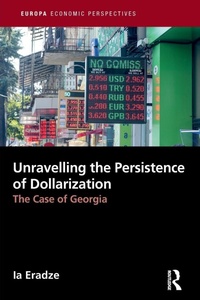
Unravelling The Persistence of Dollarization
The Case of Georgia
1st Edition
Published on 27. May 2024
Book
Paperback/Softback
240 pages
978-1-032-14615-7 (ISBN)
Description
This volume engages with the roots, dimensions, and implications of foreign currency domination in states with a national currency. Referred to as unofficial dollarization in literature, this is a worldwide phenomenon among developing countries and has a long history.
This monograph provides a political economic analysis of dollarization in Georgia and is structured around three themes: the genesis of dollarization (1991-2003), the persistence of dollarization (2003-12) and the politicization of dollarization (2012-19). The case of Georgia is especially representative of the post-socialist transition states, but also has wider applicability.
A high level of dollarization is a significant barrier to economic growth, macroeconomic and political stability, functional monetary policy, as well as social welfare. The Covid-19 crisis and the increasing debt of developing countries in foreign currency exacerbate dollarization-related vulnerabilities for these economies.
This book will be of interest to postgraduate students in global/comparative political economy, development economics or transition economies, researchers in monetary sovereignty, central banking, exchange rate policies, currency hierarchy, money, financialization, and policy makers in dollarized countries and global institutions.
This monograph provides a political economic analysis of dollarization in Georgia and is structured around three themes: the genesis of dollarization (1991-2003), the persistence of dollarization (2003-12) and the politicization of dollarization (2012-19). The case of Georgia is especially representative of the post-socialist transition states, but also has wider applicability.
A high level of dollarization is a significant barrier to economic growth, macroeconomic and political stability, functional monetary policy, as well as social welfare. The Covid-19 crisis and the increasing debt of developing countries in foreign currency exacerbate dollarization-related vulnerabilities for these economies.
This book will be of interest to postgraduate students in global/comparative political economy, development economics or transition economies, researchers in monetary sovereignty, central banking, exchange rate policies, currency hierarchy, money, financialization, and policy makers in dollarized countries and global institutions.
More details
Series
Language
English
Place of publication
London
United Kingdom
Publishing group
Taylor & Francis Ltd
Illustrations
6 s/w Tabellen, 26 s/w Abbildungen, 26 s/w Photographien bzw. Rasterbilder
6 Tables, black and white; 26 Halftones, black and white; 26 Illustrations, black and white
Dimensions
Height: 234 mm
Width: 156 mm
Thickness: 14 mm
Weight
401 gr
ISBN-13
978-1-032-14615-7 (9781032146157)
Copyright in bibliographic data and cover images is held by Nielsen Book Services Limited or by the publishers or by their respective licensors: all rights reserved.
Schweitzer Classification
Other editions
Additional editions
E-Book
06/2023
1st Edition
Routledge
€55.49
Available for download
Francisco M. Fernandez | E.A. Castro
Unravelling The Persistence of Dollarization
The Case of Georgia
E-Book
06/2023
1st Edition
Routledge
€55.49
Available for download
Book
09/2022
1st Edition
Routledge
€197.60
Shipment within 10-20 days
Person
Ia Eradze is a researcher at the Institute for Social and Cultural Studies, Ilia State University, Tbilisi. She is also a fellow in the Legacies of Communism research network, which was initiated by the Leibniz Centre for Contemporary History in Potsdam (ZZF). Her area of research is political economy and historical evolution of finance in the post-socialist space. Her most recent pieces include Financialization of Monetary Policy in a Dollarized Economy: The case of Georgia, https://doi.org/10.1093/cje/beac019 Cambridge Journal of Economics and Taming Dollarization Hysteresis: Evidence from Post-socialist States, which will appear in an edited volume (Edward Elgar Publishing).
Content
Contents
List of Figures, Tables, and Timelines
List of Abbreviations
Acknowledgements
Part I: Dollarization and its Discontents
1 Why does Dollarization Matter and What is at Stake?
2 The Obscurities of Dollarization
Part II: The Genesis of Dollarization
3 Dollarization within the Agenda of Dollar Diplomacy and Transition
4 The Georgian State as a Vessel of Dollarization
5 Hyperinflation: The Origins of Dollarization and the Birth of the Lari
6 A New Financial System Meets Dollarization
Part III: The Persistence of Dollarization
7 The Birth of the New Georgian State
8 Financialization and The Persistence of Dollarization
Part IV: The Politicization of Dollarization
9 The Politicization of Dollarization: The Currency Crisis Unfolding
10 Conclusion
Index
List of Figures, Tables, and Timelines
List of Abbreviations
Acknowledgements
Part I: Dollarization and its Discontents
1 Why does Dollarization Matter and What is at Stake?
2 The Obscurities of Dollarization
Part II: The Genesis of Dollarization
3 Dollarization within the Agenda of Dollar Diplomacy and Transition
4 The Georgian State as a Vessel of Dollarization
5 Hyperinflation: The Origins of Dollarization and the Birth of the Lari
6 A New Financial System Meets Dollarization
Part III: The Persistence of Dollarization
7 The Birth of the New Georgian State
8 Financialization and The Persistence of Dollarization
Part IV: The Politicization of Dollarization
9 The Politicization of Dollarization: The Currency Crisis Unfolding
10 Conclusion
Index