

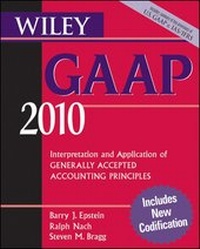
Wiley GAAP 2010
Interpretation and Application of Generally Accepted Accounting Principles
8th Edition
Published on 23. October 2009
Book
Paperback/Softback
1392 pages
978-0-470-45319-3 (ISBN)
Description
The most practical, authoritative guide to GAAP
Beginning July 1, 2009, the Financial Accounting Standards Board's (FASB's) Accounting Standards Codification (ASC) has superseded virtually all promulgated GAAP, replacing what had previously comprised four levels in the GAAP hierarchy with a single set of codified GAAP. The objective was to create a new, clearer indexing system that is much easier to access and use to research solutions to real-world financial reporting problems. Although the Codification does not itself change U.S. generally accepted accounting principles (GAAP), it has comprehensively reorganized the myriad of GAAP rules (FASB statements, AICPA statements of position, EITF consensuses, guidance from Audit and Accounting Guides, FASB staff positions, etc.) into a single, easy-to-use compendium conveniently organized by topic or subject.
Wiley GAAP 2010 contains, as did its predecessor editions, complete coverage of all levels of GAAP, now indexed to the new ASC. Wiley GAAP renders GAAP more understandable and accessible for research, and has been designed to reduce the amount of time and effort needed to solve accounting research issues. As it has since its inception in 1985, Wiley GAAP provides interpretive guidance and a wealth of real-world, content-rich examples and illustrations to provide the type of insight into the application of complex financial reporting rules that traditional handbooks and their "plain vanilla" illustrations simply cannot offer.
Wiley GAAP 2010 is your one necessary authoritative guide to GAAP under the new codification system. This invaluable resource makes learning the new ASC system a breeze, with at-your-fingertips information that does the work for you. Practicable and reliable, Wiley GAAP 2010 is the essential tool to navigate these yet uncharted waters.
More details
Edition
8., Auflage
Language
English
Place of publication
Chichester
United Kingdom
Publishing group
John Wiley and Sons Ltd
Target group
Professional and scholarly
Edition type
Revised edition
Dimensions
Height: 25 cm
Width: 15 cm
Thickness: 15 mm
Weight
666 gr
ISBN-13
978-0-470-45319-3 (9780470453193)
Schweitzer Classification
Other editions
New editions
Steven M. Bragg
Wiley GAAP
Interpretation and Application of Generally Accepted Accounting Principles 2011
Book
10/2010
1st Edition
Wiley
€97.90
Article exhausted; check for reprint
Previous edition
Barry J. Epstein | Ralph Nach | Steven M. Bragg
Wiley GAAP
Interpretation and Application of Generally Accepted Accounting Principles 2009
Book
10/2008
6th Edition
Wiley
€82.90
Article exhausted; check for reprint
Persons
Barry J. Epstein, PhD, CPA, is a partner with Chicago-based Russell Novak & Company, LLP, where he specializes in technical consultation on accounting and auditing matters and corporate governance, and maintains a national practice as a consulting and testifying expert for commercial and other litigation matters, including accountants' malpractice, contractual dispute resolution, damages modeling, and white-collar criminal defense. He has previously served in senior technical and litigation consulting positions with several regional and national CPA firms, and as a corporate finance executive and college professor. Dr. Epstein has authored or coauthored six books (including Wiley IFRS Interpretation and Application), hundreds of professional education courses, several articles in business or professional journals, and a weekly business column for an international newspaper. He has served on several state and national technical committees, including the AICPA's Board of Examiners, served as chair of the Illinois CPA Society's senior accounting technical committee, and held teaching positions at several universities. Dr. Epstein received his doctorate from the University of Pittsburgh, and also holds degrees from DePaul University and the University of Chicago. He is a member of the Illinois CPA Society, the AICPA, and the American Accounting Association.
Ralph Nach, CPA, is President and CEO of SkillSmart LLC, a Glenview, Illinois, based training and consulting firm. Mr. Nach writes, teaches, and consults on a wide range of accounting, auditing, quality management, and financial reporting matters. He has been a practitioner for over thirty years, during which he has served in capacities including accountant, auditor, quality control director, peer reviewer, educator, chief learning officer, and consultant for several public accounting firms, including Arthur Anderson LLP. Mr. Nach also served as a partner in the National Office of Audit and Accounting of McGladrey & Pullen, LLP. Mr. Nach holds a BSBA with honors from the Walter E. Heller School of Business Administration of Roosevelt University in Chicago, and is a licensed CPA in Illinois. He is a former adjunct lecturer in graduate accounting and finance at Northwestern University in Evanston, Illinois. Mr. Nach has coauthored several other books and speaks nationally on accounting, auditing, and financial reporting topics. He is a member of the American Institute of Certified Public Accountants and the Illinois CPA Society, where he has served as a chairman and/or member of numerous committees, and is an associate member of the Association of Certified Fraud Examiners. Mr. Nach was recently appointed as a charter member of the Dean's Advisory Council of the business school of his alma mater, Roosevelt University.
Steven Bragg, CPA, CMA, CIA, CPIM, has been the chief financial officer or controller of four companies, as well as a consulting manager at Ernst & Young and auditor at Deloitte & Touche. He received a master's degree in finance from Bentley College, an MBA from Babson College, and a Bachelor's degree in Economics from the University of Maine. He is the author of 28 books, including Accounting Best Practices, The Ultimate Accountants' Reference, and Controllership. He has been the two-time president of the Colorado Mountain Club. He resides with his wife and two daughters in Centennial, Colorado. Sign up for his free accounting best practices newsletter at www.stevebragg.com.
Content
Codification Taxonomy.
1 Researching GAAP Matters.
2 Statement of Financial Position.
3 Statements of Income and Comprehensive Income.
4 Statement of Cash Flows.
5 Accounting Policies, Changes, and Restatements.
6 Fair Value.
7 Cash, Receivables, and Prepaid Expenses.
8 Short-Term Investments and Financial Instruments.
9 Inventory.
10 Revenue Recognition--Evolving Principles and Specialized Applications.
11 Long-Lived Assets.
12 Long-Term Investments.
13 Business Combinations and Consolidated Financial Statements.
14 Current Liabilities and Contingencies.
15 Long-Term Liabilities.
16 Leases.
17 Income Taxes.
18 Pensions and Other Postretirement Benefits.
19 Stockholders' Equity.
Appendix A: Financial Statement Presentation.
20 Earnings Per Share.
Appendix: Comprehensive Example.
21 Interim Reporting.
22 Segment Reporting.
23 Foreign Currency.
Appendix: Accounts to Be Remeasured Using Historical Exchange Rates.
24 Personal Financial Statements.
Appendix: Hypothetical Set of Personal Financial Statements.
25 Specialized Industry GAAP.
Appendix A: Disclosure Checklist.
Appendix B: International vs. US Accounting Standards.
Index.