

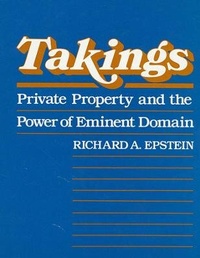
Takings
Private Property and the Power of Eminent Domain
Published on 1. January 1985
Book
Paperback/Softback
376 pages
978-0-674-86729-1 (ISBN)
Description
If legal scholar Richard Epstein is right, then the New Deal is wrong, if not unconstitutional. Epstein reaches this sweeping conclusion after making a detailed analysis of the eminent domain, or takings, clause of the Constitution, which states that private property shall not be taken for public use without just compensation. In contrast to the other guarantees in the Bill of Rights, the eminent domain clause has been interpreted narrowly. It has been invoked to force the government to compensate a citizen when his land is taken to build a post office, but not when its value is diminished by a comprehensive zoning ordinance.
Epstein argues that this narrow interpretation is inconsistent with the language of the takings clause and the political theory that animates it. He develops a coherent normative theory that permits us to distinguish between permissible takings for public use and impermissible ones. He then examines a wide range of government regulations and taxes under a single comprehensive theory. He asks four questions: What constitutes a taking of private property? When is that taking justified without compensation under the police power? When is a taking for public use? And when is a taking compensated, in cash or in kind?
Zoning, rent control, progressive and special taxes, workers' compensation, and bankruptcy are only a few of the programs analyzed within this framework. Epstein's theory casts doubt upon the established view today that the redistribution of wealth is a proper function of government. Throughout the book he uses recent developments in law and economics and the theory of collective choice to find in the eminent domain clause a theory of political obligation that he claims is superior to any of its modern rivals.
Epstein argues that this narrow interpretation is inconsistent with the language of the takings clause and the political theory that animates it. He develops a coherent normative theory that permits us to distinguish between permissible takings for public use and impermissible ones. He then examines a wide range of government regulations and taxes under a single comprehensive theory. He asks four questions: What constitutes a taking of private property? When is that taking justified without compensation under the police power? When is a taking for public use? And when is a taking compensated, in cash or in kind?
Zoning, rent control, progressive and special taxes, workers' compensation, and bankruptcy are only a few of the programs analyzed within this framework. Epstein's theory casts doubt upon the established view today that the redistribution of wealth is a proper function of government. Throughout the book he uses recent developments in law and economics and the theory of collective choice to find in the eminent domain clause a theory of political obligation that he claims is superior to any of its modern rivals.
Reviews / Votes
A dazzling book, filled with brilliant insights and powerful arguments that promise to reshape our thinking in political philosophy. * Laissez Faire Books * This brilliant new book has the intriguing thesis that the eminent domain (or 'takings') clause of the United States Constitution, properly understood, provides clear limits to government power, protects private property, and forbids any legislation that has the effect of redistributing wealth... It would be hard to overestimate [its] importance. * The Freeman * Takings...makes a fascinating case that the New Deal is, simply, unconstitutional. * Wall Street Journal * [Epstein] combines legal scholarship and libertarian conviction to produce a brief against the destruction of property rights in modern America... A refreshing challenge to most conventional defenses of the welfare state. * National Review *More details
Language
English
Place of publication
Cambridge, Mass
United States
Target group
Professional and scholarly
US School Grade: College Graduate Student
Illustrations
none
Dimensions
Height: 235 mm
Width: 156 mm
Thickness: 23 mm
Weight
526 gr
ISBN-13
978-0-674-86729-1 (9780674867291)
Copyright in bibliographic data and cover images is held by Nielsen Book Services Limited or by the publishers or by their respective licensors: all rights reserved.
Schweitzer Classification
Other editions
Additional editions
E-Book
07/2009
Harvard University Press
€44.59
Available for download
Person
Richard A. Epstein is Laurence A. Tisch Professor of Law at New York University School of Law, Peter and Kirsten Bedford Senior Fellow at the Hoover Institution, and James Parker Hall Distinguished Service Professor Emeritus of Law and Senior Lecturer at the University of Chicago Law School. He is the author of, among other books, Takings: Private Property and the Power of Eminent Domain; Simple Rules for a Complex World; Design for Liberty: Private Property, Public Administration, and the Rule of Law; and The Dubious Morality of Modern Administrative Law.
Content
Philosophical Preliminaries A Tale of Two Pies Hobbesian Man, Lockean World The Integrity of Constitutional Text Takings Prima Facie Takings and Torts Partial Takings: The Unity of Ownership Possession and Use Rights of Disposition and Contract Taking from Many: Liability Rules, Regulations, and Taxes Justifications for Takings The Police Power: Ends The Police Power: Means Consent and Assumption of Risk Public Use and Just Compensation Public Use Explicit Compensation Implicit In-Kind Compensation Property and the Common Pool Regulation Taxation Transfer Payments and Welfare Rights Conclusion: Philosophical Implications Index of Cases General Index