

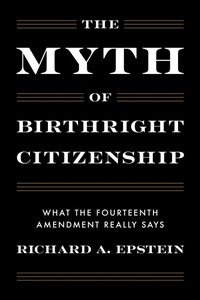
The Myth of Birthright Citizenship
What the Fourteenth Amendment Really Says
Will be published approx. on 16. July 2026
Book
Hardback
296 pages
978-1-64177-522-9 (ISBN)
Description
The Citizenship Clause of the Fourteenth Amendment of the U.S. Constitution seems quite simple. Yet it is embroiled in one of the most contentious constitutional battles of our time: birthright citizenship. In The Myth of Birthright Citizenship, Richard A. Epstein explains what the Constitution actually says about citizenship-and what it doesn't.
Many believe that the Citizenship Clause bestows citizenship upon anyone born in the United States, but Epstein explains why this understanding is profoundly wrong. On the contrary, acquiring citizenship requires one to be "subject to the jurisdiction" of a sovereign-or to offer loyalty in exchange for protection. It is not sufficient to obtain citizenship by simply living "within [the] jurisdiction" of a state. Therefore, mere birth of an alien in the U.S. does not grant him citizenship but only allows him, as a minor, to be naturalized when his parents are naturalized.
Epstein's powerful evidence for this position comes from a close textual analysis of the Constitution. It is enriched by a study of the overlooked Naturalization Acts from 1790 to 1870; the writings of such giants as William Blackstone and Emmerich de Vattel before the American Revolution; the mixed reception of English practice in America after the Revolutionary War at both the state and federal levels; and the case law and institutional practices in this country both before and after the Civil War, which include a study of black and Chinese naturalization history.
The book also examines how earlier debates over birthright citizenship have helped shape the evolution of constitutional doctrine throughout the twentieth century on such key questions as voting rights, segregated schools, takings, taxation, and unconstitutional conditions. It further examines the responses of judges and commentators to President Trump's January 20, 2025, executive order prohibiting the executive branch from issuing documents recognizing the citizenship of those claiming birthright citizenship.
Many believe that the Citizenship Clause bestows citizenship upon anyone born in the United States, but Epstein explains why this understanding is profoundly wrong. On the contrary, acquiring citizenship requires one to be "subject to the jurisdiction" of a sovereign-or to offer loyalty in exchange for protection. It is not sufficient to obtain citizenship by simply living "within [the] jurisdiction" of a state. Therefore, mere birth of an alien in the U.S. does not grant him citizenship but only allows him, as a minor, to be naturalized when his parents are naturalized.
Epstein's powerful evidence for this position comes from a close textual analysis of the Constitution. It is enriched by a study of the overlooked Naturalization Acts from 1790 to 1870; the writings of such giants as William Blackstone and Emmerich de Vattel before the American Revolution; the mixed reception of English practice in America after the Revolutionary War at both the state and federal levels; and the case law and institutional practices in this country both before and after the Civil War, which include a study of black and Chinese naturalization history.
The book also examines how earlier debates over birthright citizenship have helped shape the evolution of constitutional doctrine throughout the twentieth century on such key questions as voting rights, segregated schools, takings, taxation, and unconstitutional conditions. It further examines the responses of judges and commentators to President Trump's January 20, 2025, executive order prohibiting the executive branch from issuing documents recognizing the citizenship of those claiming birthright citizenship.
Reviews / Votes
Anyone interested in the meaning of American citizenship will have to wrestle with Richard Epstein's unique and provocative critique of birthright.-John Yoo, Emanuel S. Heller Chair in Law, Distinguished Professor of Law,
University of California at Berkeley Richard Epstein has marshalled his knowledge, meticulousness, and impeccable logic, to add his name to the growing number of scholars who recognize that the 14th Amendment's Citizenship Clause does not confer automatic citizenship on the children of illegal aliens or temporary visitors. Epstein's work exposes how following the old English feudal rule of jus soli deviates from the original intent of those who drafted and ratified the 14th Amendment - a major contribution to the debate.
-John Eastman, Senior Fellow, The Claremont Institute A common reaction to the writings of the conservative legal scholar Richard A. Epstein is that they are simultaneously outrageous and completely convincing.
- The New York Times Book Review Richard A. Epstein, a law professor at the University of Chicago, is one of the stars in the firmament of conservative intellectuals.
- The New York Times Book Review
More details
Language
English
Place of publication
New York
United States
Target group
College/higher education
Product notice
Cloth over boards
Illustrations
Illustrations
Dimensions
Height: 229 mm
Width: 153 mm
Thickness: 16 mm
Weight
401 gr
ISBN-13
978-1-64177-522-9 (9781641775229)
Copyright in bibliographic data and cover images is held by Nielsen Book Services Limited or by the publishers or by their respective licensors: all rights reserved.
Schweitzer Classification
Person
Richard A. Epstein is the Laurence A. Tisch Professor at NYU; a senior fellow at the Civitas Institute at the University of Texas-Austin and a senior lecturer and professor emeritus at the University of Chicago. He is the author of many books and articles, including Takings (1985), Simple Rules for a Complex World (1995) and the Classical Liberal Constitution (2014). He is a regular podcaster and columnist whose work widely.