

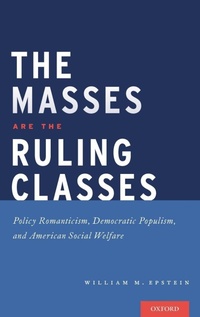
The Masses are the Ruling Classes
Policy Romanticism, Democratic Populism, and Social Welfare in America
Published on 27. April 2017
Book
Hardback
280 pages
978-0-19-046706-7 (ISBN)
Description
The Masses are the Ruling Classes proposes the radical, yet seemingly innocuous view that social policy in the United States is determined by mass consent. Contemporary explanations of decision making in the US typically attribute power over policy making to a variety of hidden forces and illegitimate elites holding the masses innocent of their own problems. Yet the enormous openness of the society and near-universal suffrage sustain democratic consent as more plausible than the alternatives -- conspiracy, propaganda, usurpation, autonomous government, and imperfect pluralism. Contrary to prevailing explanations, government is not either autonomous or out of control, business and wealthy individuals have not usurped control of the nation, large segments of the population are not dispossessed of the vote or of a voice in public affairs, and the media has not formed a conspiracy with Hollywood and liberals to deny Americans their God-given freedoms. Despite the multitude of problems that the nation faces, its citizens are not oppressed. In this pithy yet provocative book, Epstein argues that Democracy in the United States is not progressive but is instead populist, and that the core of the populist ideology is romantic rather than pragmatic.
Reviews / Votes
In Epstein's hands, populism refers more to pervasive cultural sensibilities, shared by the mass of the American public, than to the personalities, policies or political strategies of individual political figures. And his contention is that politicians must adhere to these populist cultural sensibilities if they are to succeed electorally. * The European Legacy * "While this book contains no reference to Trump, the cultural logic it unfolds in the context of current events provides such a convincing explanation of his rise that it is difficult to avoid reading it in that way. Epstein's conclusions are troubling news for believers in the virtues of the public sphere and likely a bitter pill for many of Trump's American detractors to swallow." * Andrew Simon Gilbert, The European Legacy * Epstein has succeeded in revealing the sometimes unhealthy symbiosis between the psychology professions and the democratic societies that nurture them. For this reason alone, his book deserves a wide readership. If you are an applied psychologist, it may even change the way you practice. * Paul Moloney, Counselling Psychologist at the Royal Shrewsbury Hospital, The Psychologist *More details
Language
English
Place of publication
New York
United States
Target group
College/higher education
Dimensions
Height: 240 mm
Width: 161 mm
Thickness: 19 mm
Weight
581 gr
ISBN-13
978-0-19-046706-7 (9780190467067)
Copyright in bibliographic data and cover images is held by Nielsen Book Services Limited or by the publishers or by their respective licensors: all rights reserved.
Schweitzer Classification
Other editions
Additional editions
William Epstein
The Masses are the Ruling Classes
Policy Romanticism, Democratic Populism, and Social Welfare in America
E-Book
03/2017
1st Edition
OUP eBook
€33.99
Available for download
William Epstein
The Masses are the Ruling Classes
Policy Romanticism, Democratic Populism, and Social Welfare in America
E-Book
03/2017
1st Edition
OUP eBook
€33.99
Available for download
Person
William Epstein, DSW, MSW, is Professor at the University of Nevada, Las Vegas School of Social Work. Dr. Epstein has authored nine books and scores of articles, reviews, and research monographs. He has over 30 years of university teaching and 15 years of experience in community organization and development, public administration, and policy research.
Content
Acknowledgements
Preface
Section I: Explaining Social Policy Making
Introduction: The Ruling Masses
Chapter 1: Precursors to Policy Romanticism
Chapter 2: Policy Romanticism
Chapter 3: -- An American Archetype: The Quest for the Authentic Self -- Psychology, Pop Psychology and Self-Help
Chapter 4: Spiritualism, Religion and Other Romantic Quests for the Authentic Self
Section II: Policy Romanticism and American Social Welfare
Chapter 5: Year Up
Chapter6: Communities in Schools
Chapter7: Generations of Hope Communities
Chapter 8: The Food Stamp Program
Chapter 9 - Food Stamps and Public Welfare
Conclusion
Social Adolescence
Preface
Section I: Explaining Social Policy Making
Introduction: The Ruling Masses
Chapter 1: Precursors to Policy Romanticism
Chapter 2: Policy Romanticism
Chapter 3: -- An American Archetype: The Quest for the Authentic Self -- Psychology, Pop Psychology and Self-Help
Chapter 4: Spiritualism, Religion and Other Romantic Quests for the Authentic Self
Section II: Policy Romanticism and American Social Welfare
Chapter 5: Year Up
Chapter6: Communities in Schools
Chapter7: Generations of Hope Communities
Chapter 8: The Food Stamp Program
Chapter 9 - Food Stamps and Public Welfare
Conclusion
Social Adolescence