

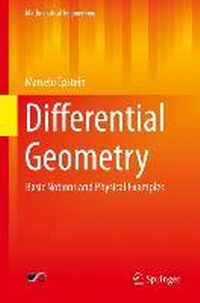
Differential Geometry
Basic Notions and Physical Examples
Published on 15. July 2014
Book
Hardback
XI, 139 pages
978-3-319-06919-7 (ISBN)
Description
Differential Geometry offers a concise introduction to some basic notions of modern differential geometry and their applications to solid mechanics and physics.
Concepts such as manifolds, groups, fibre bundles and groupoids are first introduced within a purely topological framework. They are shown to be relevant to the description of space-time, configuration spaces of mechanical systems, symmetries in general, microstructure and local and distant symmetries of the constitutive response of continuous media.
Once these ideas have been grasped at the topological level, the differential structure needed for the description of physical fields is introduced in terms of differentiable manifolds and principal frame bundles. These mathematical concepts are then illustrated with examples from continuum kinematics, Lagrangian and Hamiltonian mechanics, Cauchy fluxes and dislocation theory.
This book will be useful for researchers and graduate students in science and engineering.
Concepts such as manifolds, groups, fibre bundles and groupoids are first introduced within a purely topological framework. They are shown to be relevant to the description of space-time, configuration spaces of mechanical systems, symmetries in general, microstructure and local and distant symmetries of the constitutive response of continuous media.
Once these ideas have been grasped at the topological level, the differential structure needed for the description of physical fields is introduced in terms of differentiable manifolds and principal frame bundles. These mathematical concepts are then illustrated with examples from continuum kinematics, Lagrangian and Hamiltonian mechanics, Cauchy fluxes and dislocation theory.
This book will be useful for researchers and graduate students in science and engineering.
Reviews / Votes
"The book under review has grown out of lecture notes for a mini-course given at a workshop on differential geometry and continuum mechanics at the International Centre for Mathematical Sciences in 2013. ... addressing researchers and engineers in particular, Epstein's book provides a ... quick way to appreciate modern differential geometry and topology and get to their essential ideas and usefulness. Surely, Epstein manages to give the reader a motivation to delve into the deep waters of these two fields." (Theophanes Grammenos, Mathematical Reviews, June, 2015) "This book is based on a short course on 'Differential Geometry and Continuum Mechanics' given by Marcelo Epstein at the International Centre of Mathematical Sciences in Edinburgh in June 2013. The course provided a guided tour of differential geometry for researchers and graduate students in science and engineering - many of whom had a particular interest in continuum mechanics. ... this book is a gold mine of aesthetically pleasing mathematical ideas, the presentation of which is highly inspirational." (P. N. Ruane, MAA Reviews, December, 2014)More details
Product info
Book
Series
Language
English
Place of publication
Cham
Switzerland
Target group
Research
Illustrations
26 s/w Abbildungen
26 schwarz-weiße Abbildungen, Bibliographie
Dimensions
Height: 242 mm
Width: 159 mm
Thickness: 15 mm
Weight
377 gr
ISBN-13
978-3-319-06919-7 (9783319069197)
DOI
10.1007/978-3-319-06920-3
Schweitzer Classification
Other editions
Additional editions
Book
09/2016
Springer
€128.39
Shipment within 10-15 days
E-Book
07/2014
1st Edition
Springer
€117.69
Available for download
Person
Marcelo Epstein is Professor of Mechanical Engineering at the University of Calgary, where he has held the title of University Professor of Rational Mechanics. A Fellow of the American Academy of Mechanics and a recipient of the CANCAM award, he has published extensively in the field of the foundations and applications of continuum mechanics. He is the author or co-author of four books on various aspects of applied differential geometry, continuum mechanics and biomechanics.
Content
Topological constructs.- Physical illustrations.- Differential constructs.- Physical illustrations.