

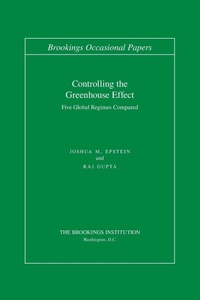
Controlling the Greenhouse Effect
Five Global Regimes Compared
Published on 1. October 1990
Book
Paperback/Softback
48 pages
978-0-8157-2465-0 (ISBN)
Description
Roughly 30 percent of the solar radiation directed toward the earth is reflected directly back into outer space. The remaining 70 percent is absorbed by earth and re-emitted outward as long-wave?or infra-red?radiation. While transparent to incoming solar radiation, certain gases--notably carbon dioxide, nitrous oxide, methane, and chlorofluorocarbons?absorb, or ""trap,"" this outgoing infra-red radiation near the earth's surface, producing an increase in temperature. This is the so-called greenhouse effect. The greater the concentration of these greenhouse gases, the more pronounced will be the effect. Despite uncertainties, the scientific consensus recorded at Villach, Austria, in 1985 was that ""the understanding of the greenhouse question is sufficiently developed that scientists and policy-makers should begin an active collaboration to explore the effectiveness of alternatives and adjustments."" The recent scientific assessment of climate change, conducted under the auspices of the UN Intergovernmental Panel on Climate Change, has only strengthened the view that a concerted multilateral response is called for.
More details
Language
English
Place of publication
United States
Publishing group
Bloomsbury Publishing Plc
Target group
Professional and scholarly
Dimensions
Height: 229 mm
Width: 152 mm
Thickness: 3 mm
Weight
86 gr
ISBN-13
978-0-8157-2465-0 (9780815724650)
Copyright in bibliographic data and cover images is held by Nielsen Book Services Limited or by the publishers or by their respective licensors: all rights reserved.
Schweitzer Classification
Other editions
Additional editions
E-Book
12/2010
1st Edition
Brookings Institution
€11.99
Available for download
E-Book
12/2010
Bloomsbury eBooks US
€11.99
Available for download
Persons
Joshua M. Epstein is senior fellow in the Brookings Foreign Policy Studies program and teaches at Princeton University. He is author of Strategy and Force Planning: The Case of the Persian Gulf (1987). The Calculus of Conventional War (1985), and The 1987 Defense Budget and The 1988 Defense Budget. Raj Gupta is a consultant to Brookings and works in risk arbitage at Goldman Sachs.