

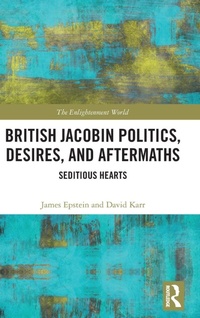
British Jacobin Politics, Desires, and Aftermaths
Seditious Hearts
1st Edition
Published on 16. February 2021
Book
Hardback
388 pages
978-0-367-46444-8 (ISBN)
Description
This book explores the hopes, desires, and imagined futures that characterized British radicalism in the 1790s, and the resurfacing of this sense of possibility in the following decades. The articulation of "Jacobin" sentiments reflected the emotional investments of men and women inspired by the French Revolution and committed to political transformation. The authors emphasize the performative aspects of political culture, and the spaces in which mobilization and expression occurred - including the club room, tavern, coffeehouse, street, outdoor meeting, theater, chapel, courtroom, prison, and convict ship. America, imagined as a site of republican citizenship, and New South Wales, experienced as a space of political exile, widened the scope of radical dreaming. Part 1 focuses on the political culture forged under the shifting influence of the French Revolution. Part 2 explores the afterlives of British Jacobinism in the year 1817, in early Chartist memorialization of the Scottish "martyrs" of 1794, and in the writings of E. P. Thompson. The relationship between popular radicals and the Romantics is a theme pursued in several chapters; a dialogue is sustained across the disciplinary boundaries of British history and literary studies. The volume captures the revolutionary decade's effervescent yearning, and its unruly persistence in later years.
Reviews / Votes
"This collection of essays moves the history of British Jacobinism to a different plane by astutely exploring the interconnections of power, representation and performativity. The erudition and range of topics addressed is very impressive, tracking the radical past in taverns, coffee houses, theatres, prisons and convict ships. The book delves into the democratic promise of America and into Jacobin's afterlife as a displaced form of reference. It ends with an astute exploration of E. P. Thompson's reflections on Romanticism and revolution and its pertinence to his political perspective during World War II and its aftermath. For literary, social and cultural historians of the late eighteenth century, this is essential reading."Nicholas Rogers, Distinguished Research Professor, York University, Toronto, Canada
"British Jacobin Politics is a lively and well researched study of the early democratic movement in Britain. Epstein and Karr give a fascinating insight into the emotional impulses that motivated political radicalism in Britain during a tumultuous period of European revolution. They take us deep into the theatres, coffee houses and prisons where British Jacobinism was formed and performed, and follow its significant legacy into Chartism. This book will be essential for historians and students of the age of revolution."
Katrina Navickas, Reader in History, University of Hertfordshire, UK
More details
Series
Language
English
Place of publication
London
United Kingdom
Publishing group
Taylor & Francis Ltd
Target group
College/higher education
Illustrations
14 s/w Abbildungen, 13 s/w Photographien bzw. Rasterbilder, 1 s/w Zeichnung
1 Line drawings, black and white; 13 Halftones, black and white; 14 Illustrations, black and white
Dimensions
Height: 235 mm
Width: 157 mm
Thickness: 26 mm
Weight
736 gr
ISBN-13
978-0-367-46444-8 (9780367464448)
Copyright in bibliographic data and cover images is held by Nielsen Book Services Limited or by the publishers or by their respective licensors: all rights reserved.
Schweitzer Classification
Other editions
Additional editions
Book
08/2022
1st Edition
Routledge
€68.80
Shipment within 15-20 days
E-Book
01/2021
1st Edition
Routledge
€60.49
Available for download
E-Book
01/2021
1st Edition
Routledge
€60.49
Available for download
Persons
James Epstein is Emeritus Distinguished Professor of History, Vanderbilt University.
David Karr is a Professor of History at Columbia College in Columbia, Missouri.
David Karr is a Professor of History at Columbia College in Columbia, Missouri.
Content
Introduction 1
PART 1
Seditious Hearts: 1790s 17
1 Playing at Revolution: British "Jacobin" Performance 19
2 Everyday Life and Everyday Sedition: Situating Radical Identities 54
3 "Thoughts That Flash Like Lightning": Thomas Holcroft and Radical Theater 86
4 "Equality and No King": Sociability and Sedition 121
5 Writing America from Newgate Prison, 1795 149
PART 2
Aftermaths and Recurrence 195
6 1817: Return of the Suppressed 197
7 "The Embers of Expiring Sedition": Maurice Margarot, the Scottish Martyrs Monument, and Radical Memory across the South Pacific 254
8 Among the Romantics: E. P. Thompson and the Poetics of Disenchantment 293
Works Cited 329
Index 375
PART 1
Seditious Hearts: 1790s 17
1 Playing at Revolution: British "Jacobin" Performance 19
2 Everyday Life and Everyday Sedition: Situating Radical Identities 54
3 "Thoughts That Flash Like Lightning": Thomas Holcroft and Radical Theater 86
4 "Equality and No King": Sociability and Sedition 121
5 Writing America from Newgate Prison, 1795 149
PART 2
Aftermaths and Recurrence 195
6 1817: Return of the Suppressed 197
7 "The Embers of Expiring Sedition": Maurice Margarot, the Scottish Martyrs Monument, and Radical Memory across the South Pacific 254
8 Among the Romantics: E. P. Thompson and the Poetics of Disenchantment 293
Works Cited 329
Index 375