

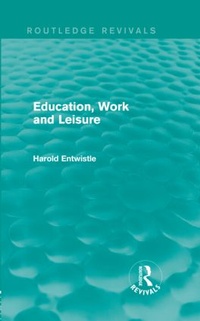
Education, Work and Leisure (Routledge Revivals)
1st Edition
Published on 18. March 2013
Book
Hardback
120 pages
978-0-415-83494-0 (ISBN)
Description
First published in 1970, this book considers the alleged distinction between 'education for life' and 'education for work' and exposes the fallacies on which this and other similar distinctions are based. It shows that ideas on this subject are inextricably intertwined with wider views on the nature of culture, the limits of individual educability and the provision of educational opportunities. Indeed, Dr Entwistle argues that students need to be well informed of these issues in order to be in a strong enough position to face problems of education and social development that will occur during their working lives.
More details
Series
Language
English
Place of publication
London
United Kingdom
Publishing group
Taylor & Francis Ltd
Target group
College/higher education
Dimensions
Height: 216 mm
Width: 138 mm
Weight
1080 gr
ISBN-13
978-0-415-83494-0 (9780415834940)
Copyright in bibliographic data and cover images is held by Nielsen Book Services Limited or by the publishers or by their respective licensors: all rights reserved.
Schweitzer Classification
Other editions
Additional editions
Harold Entwistle
Education, Work and Leisure (Routledge Revivals)
Book
09/2014
1st Edition
Routledge
€75.40
Shipment within 15-20 days
Harold Entwistle
Education, Work and Leisure (Routledge Revivals)
E-Book
06/2014
1st Edition
Routledge
€69.99
Available for download
Harold Entwistle
Education, Work and Leisure (Routledge Revivals)
E-Book
06/2014
1st Edition
Routledge
€69.99
Available for download
Person
Harold Entwistle
Content
1. Education: for Living or Earning a Living? 2. Leisure, Work and Personal Realisation 3. Employment opportunities in an Automated Economy 4. Automation and the Limits of Human Educability 5. The Vocabulary of Vocational Education 6. Technical Education 7. Vocational Education in schools 8. Moral, Aesthetic, Social and Political Education in Automated Society 9. Conclusion; Bibliography