

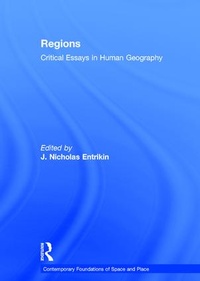
Regions
Critical Essays in Human Geography
1st Edition
Will be published approx. on 14. November 2008
Book
Hardback
636 pages
978-0-7546-2692-3 (ISBN)
Description
This volume gathers a collection of the most seminal essays written by leading experts in the field, which identify or signal many of the changing directions of regional research in geography during the past fifty years. Various forms of 'new regionalism' or 'new regional geography' have emerged over the last several decades, especially in political and economic geography, but in general the region has been a concept in declining use. Despite this, the region has gained new currency in sub-areas of political and economic geography and a so-called 'new regionalism' has emerged in studies of the changing nature of the nation-state in a globalizing economy. Taken together, the essays in this volume provide the reader with a comprehensive overview of academic developments in this area of geographical research.
More details
Series
Language
English
Place of publication
London
United Kingdom
Publishing group
Taylor & Francis Ltd
Target group
Professional and scholarly
Dimensions
Height: 246 mm
Width: 174 mm
Weight
1428 gr
ISBN-13
978-0-7546-2692-3 (9780754626923)
Copyright in bibliographic data and cover images is held by Nielsen Book Services Limited or by the publishers or by their respective licensors: all rights reserved.
Schweitzer Classification
Other editions
Person
J. Nicholas Entrikin is Professor of Geography at the University of California at Los Angeles, USA.
Content
Contents: Introduction; Part I Regional Geography and Spatial Analysis: Between regions: science, militarism, and American geography from World War to Cold War, Trevor J. Barnes and Matthew Farish; Chorology and spatial analysis, Robert David Sack; The highest form of the geographer's art, John Fraser Hart; The institutionalization of regions: a theoretical framework for understanding the emergence of regions and the constitution of regional identity, Anssi Paasi. Part II Region, Structure and Process: Regionalism: some current issues, Doreen Massey; Place as historically contingent process: structuration and the time-geography of becoming places, Allan Pred; Regions in context: spatiality, periodicity and the historical geography of the regional question, E.W. Soja; Taking aim at the heart of the region, Nigel Thrift. Part III Regions and International Political Integration: Principles of regionalism, John A. Agnew; Emerging regional linkages within the European Community: challenging the dominance of the state, Alexander Murphy; Europeanism and regionalism, Michael Keating; Regionalization for Turkey: an illusion or a cure?, Murat Ali DulupA?u. Part IV 'New Regionalism', Globalization and Global City Regions: World-systems analysis and regional geography, Peter J. Taylor; The resurgence of regional economies, 10 years later: the region as a nexus of untraded interdependencies, Michael Storper; New regionalism reconsidered: globalization and the remaking of political economic space, Gordon MacLeod; Theory led by policy: the inadequacies of the 'new regionalism', John Lovering; Globalization and the rise of city-regions, Allen J. Scott. Part V Regions and the Politics of Place: Regions unbound: towards a new politics of place, Ash Amin; Bounded spaces in the mobile world: deconstructing 'regional identity', Anssi Paasi; The rhetoric of regionalism: the Northern League in Italian politics, 1983-94, John Agnew; The making of the Mitteldeutschland on the function of