

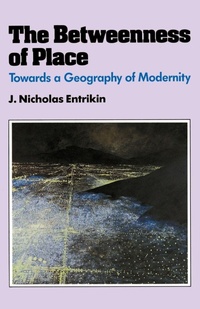
The Betweenness of Place
Towards a Geography of Modernity
Published on 19. January 1991
Book
Paperback/Softback
204 pages
978-0-8018-4084-5 (ISBN)
Description
What makes New York City different from Moscow? Are small towns looking more and more alike? What criteria should we use to distinguish onw place from another? Today, geographers and other social scientists are debating not only the answers to these sorts of questions but even whether or not to ask them at all. This ongoing controversy about how (or whether) to study place and its meaning in modern life forms the focus of J. Nicholas Entrikin's pioneering work. Those who point to a decline in the study of place in geography, Entrikin explains, cite three main causes: the apparent homogenization of world culture; the belief that studying particular places is somehow "parochial"; and the tendency of the scientific method to generalize. Entrikin treats each of these in turn, addressing topics that include the Marxist view of a world economy, the moral implications of place (in such notions as community and provincialism), and the empiricist versus neo-Kantian traditions in philosophy. To geographers arguing the merits of hard, scientific data versus subjective experience, Entrikin offers a compromise."To understand place", he suggests, "requires that we have access to both an objective and a subjective reality.
From the decentered vantage point of the theoretical scientist, place becomes either location or a set of generic relations and loses much of its significance for human action. From the centered viewpoint of the subjective self, place has meaning only in relation to one's own goals and concerns. Place is best viewed from points in-between."
From the decentered vantage point of the theoretical scientist, place becomes either location or a set of generic relations and loses much of its significance for human action. From the centered viewpoint of the subjective self, place has meaning only in relation to one's own goals and concerns. Place is best viewed from points in-between."
Reviews / Votes
In this dense forest of theories and perspectives, we need a guide who is sympathetic to, yet critical of, the different viewpoints, who appreciates what older geographers have done without nostalgia for their less self-conscious approach, and who, above all, has a historical perspective. J. Nicholas Entrikin is such a guide. -- Yi-Fu Tuan Geographical ReviewMore details
Language
English
Place of publication
Baltimore, MD
United States
Product notice
Paperback (trade)
Dimensions
Height: 216 mm
Width: 140 mm
Thickness: 13 mm
Weight
306 gr
ISBN-13
978-0-8018-4084-5 (9780801840845)
DOI
10.56021/9780801840838
Copyright in bibliographic data and cover images is held by Nielsen Book Services Limited or by the publishers or by their respective licensors: all rights reserved.
Schweitzer Classification
Other editions
Additional editions

Book
02/1991
Johns Hopkins University Press
€54.05
Article exhausted; check different version
Person
J. Nicholas Entrikin is professor of geography at the University of California, Los Angeles.
Content
Preface
Acknowledgments
Chapter 1. Introduction
Chapter 2. The Betweenness of Place
Chapter 3. Place, Region, and Modernity
Chapter 4. The Empirical-Theoretical Significance of Place and Region
Chapter 5. Normative Significance
Chapter 6. Epistemological Significance
Chapter 7. Casual Understanding, Narrative and Geographic Synthesis
Chapter 8. Conclusion
Notes
Author Index
Subject Index
Acknowledgments
Chapter 1. Introduction
Chapter 2. The Betweenness of Place
Chapter 3. Place, Region, and Modernity
Chapter 4. The Empirical-Theoretical Significance of Place and Region
Chapter 5. Normative Significance
Chapter 6. Epistemological Significance
Chapter 7. Casual Understanding, Narrative and Geographic Synthesis
Chapter 8. Conclusion
Notes
Author Index
Subject Index