

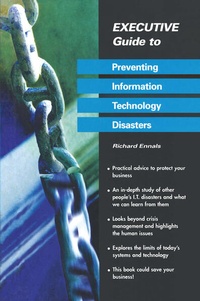
Executive Guide to Preventing Information Technology Disasters
1st Edition
Published on 15. September 1995
Book
Paperback/Softback
IX, 187 pages
978-3-540-19928-1 (ISBN)
Description
Recent and well-publicised disasters have highlighted the fact that organisations of all kinds - from healthcare to aerospace - are critically dependent on Information Technology systems. The prevention of catastrophic I.T. failure is now an essential part of management.
In this thought-provoking guide for executives and managers Richard Ennals argues that the critical factor is not technology, but people and communication.
In this thought-provoking guide for executives and managers Richard Ennals argues that the critical factor is not technology, but people and communication.
More details
Series
Edition
1st Edition
Language
English
Place of publication
London
United Kingdom
Publishing group
Springer Berlin
Target group
Professional and scholarly
Professional/practitioner
Illustrations
IX, 187 p.
Dimensions
Height: 235 mm
Width: 155 mm
Thickness: 12 mm
Weight
312 gr
ISBN-13
978-3-540-19928-1 (9783540199281)
DOI
10.1007/978-1-4471-0383-7
Schweitzer Classification
Other editions
Additional editions
E-Book
12/2012
Springer
€53.49
Available for download
Content
1. Introduction.- Disasters: Some Examples.- Disaster Prevention Through Skill.- Fraud: Management in Crisis.- Systems and Decision-Making.- Strategic Functions.- Technical Issues.- Organisational Cultural Issues.- Intelligent Solutions.- How to Cause IT Disasters.- 2. Historical and Technical Perspectives.- Single Technology Solutions.- Tools.- Keeping IT Simple.- The Emperor's Old Clothes.- Human-Centred Systems.- Executive Information Systems.- 3. Culture, Competence and Complexity.- The Demands of the Modern Economy.- Challenging Professionals.- Engineering as a Form of Life.- Competence and Professional Education.- Subcontracting the Management of Complexity.- Consequences of Discontinuity.- A Question of Scale.- Working on Infeasible Projects.- The Case for Programming.- 4. Issues of Integration.- Managing IT in the Organisation.- Expert Systems and Mainstream Software.- Management and Information Systems.- Open and Distributed Systems.- Business Health.- Computer Viruses.- 5. Management Dilemmas.- Problems.- Professionals.- Panaceas.- Method.- Automation.- People.- Standards.- Quality.- Profits and Prophets.- 6. Learning from Experience.- Support Services.- From Computer Centres to Distributed Processing.- Networking the Organisation.- IT Strategy as a Process.- Who Needs to Know What?.- Crisis and Disaster.- Responsibilities.- Pragmatics.- 7. Information Technology and Business Ethics: Case Studies.- Wessex Regional Health Authority.- Compliance with Financial Services Legislation.- Training and Enterprise Councils.- Selling Solutions.- Defence and Diversification.- Marketing Quality.- Talking to Your Computer.- Arms, Technology and Business Ethics.- 8. Information Technology Consultancy.- To What Extent Can Consultants Help to Prevent IT Disasters?.-Consultants, Outsourcing and the Fear of IT Disasters.- Accountability and Responsibility.- Business Process Re-engineering.- Disasters, Strategy and Development.- 9. Ways Forward.- Education.- Economic Collapse and Change.- Learning from Political Experience.- A New Management Paradigm: Human-Centred Systems.- Disaster Recovery Planning as Strategic Planning.- Practical Next Steps.- References and Bibliography.- Name Index.