

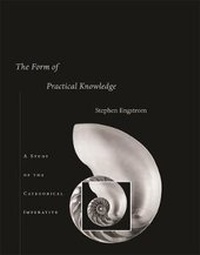
The Form of Practical Knowledge
A Study of the Categorical Imperative
Published on 1. April 2009
Book
Hardback
278 pages
978-0-674-03287-3 (ISBN)
Description
Immanuel Kant's claim that the categorical imperative of morality is based in practical reason has long been a source of puzzlement and doubt, even for sympathetic interpreters. Kant's own explanations, which mainly concern his often-criticized formula of universal law, are laconic and obscure, leading interpreters to dismiss them in favor of less ambitious claims involving his other famous formulas.
In The Form of Practical Knowledge, Stephen Engstrom provides an illuminating new interpretation of the categorical imperative, arguing that we have exaggerated and misconceived Kant's break with tradition: Kant never departs from the classical conception of practical reason as a capacity for knowledge of the good. His distinctive contribution is the idea that morality's imperatives express the form of such knowledge.
By developing an account of practical knowledge that situates Kant's ethics within his broader epistemology and rethinks numerous topics in his moral psychology and in his account of practical reason (including desire, intention, choice, will, as well as pleasure, happiness, and the good), Engstrom's work promises to deepen and to reshape our understanding of Kantian ethics.
In The Form of Practical Knowledge, Stephen Engstrom provides an illuminating new interpretation of the categorical imperative, arguing that we have exaggerated and misconceived Kant's break with tradition: Kant never departs from the classical conception of practical reason as a capacity for knowledge of the good. His distinctive contribution is the idea that morality's imperatives express the form of such knowledge.
By developing an account of practical knowledge that situates Kant's ethics within his broader epistemology and rethinks numerous topics in his moral psychology and in his account of practical reason (including desire, intention, choice, will, as well as pleasure, happiness, and the good), Engstrom's work promises to deepen and to reshape our understanding of Kantian ethics.
Reviews / Votes
Stephen Engstrom provides a highly original interpretation of the categorical imperative as the criterion of rational knowledge and action. In focusing on the general formula and the law-of-nature variant, and trying to make them work, the book presents a welcome counterweight to currently fashionable interpretations that dismiss these formulations in favour of the second variation, commonly called the "formula of humanity." -- Jens Timmermann, University of St AndrewsMore details
Language
English
Place of publication
Cambridge, Mass
United States
Target group
Adult education
US School Grade: College Graduate Student
Dimensions
Height: 235 mm
Width: 156 mm
Thickness: 25 mm
Weight
567 gr
ISBN-13
978-0-674-03287-3 (9780674032873)
Copyright in bibliographic data and cover images is held by Nielsen Book Services Limited or by the publishers or by their respective licensors: all rights reserved.
Schweitzer Classification
Other editions
Additional editions
E-Book
08/2009
Harvard University Press
€162.99
Available for download
Person
Stephen Engstrom is Professor of Philosophy at the University of Pittsburgh.
Content
* Preface * Note on Citations * Introduction Part I. Willing as Practical Knowing * The Will and Practical Judgment * Fundamental Practical Judgments: The Wish for Happiness Part II. From Presuppositions of Judgment to the Idea of a Categorical Imperative * The Formal Presuppositions of Practical Judgment * Constraints on Willing Part III. Interpretation * The Categorical Imperative * Applications * Conclusion * Epilogue * Index