

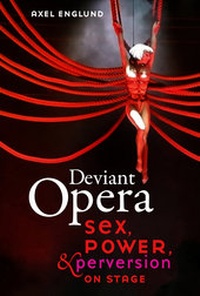
Deviant Opera
Sex, Power, and Perversion on Stage
1st Edition
Published on 6. October 2020
Book
Hardback
280 pages
978-0-520-34325-2 (ISBN)
Description
The first book to use subversive sexuality as a lens through which to provocatively view opera in the 21st century.
Imagine Armida, Handel's Saracen sorceress, performing her breakneck coloraturas in a black figure-hugging rubber dress, beating her insubordinate furies into submission with a cane, suspending a captive Rinaldo in chains from the ceiling of her dungeon. Mozart's peasant girl Zerlina, meanwhile, is tying up and blindfolding her fiance to seduce him out of his jealousy of Don Giovanni. And how about Wagner's wizard, Klingsor, ensnaring his choir of flower maidens in elaborate Japanese rope bondage?
Opera, it would appear, has developed a taste for sadomasochism. For decades now, radical stage directors have repeatedly dressed canonical operas-from Handel and Mozart to Wagner and Puccini, and beyond-in whips, chains, leather, and other regalia of SM and fetishism. Deviant Opera seeks to understand this phenomenon, approaching the contemporary visual code of perversion as a lens through which opera focuses and scrutinizes its own configurations of sex, gender, power, and violence. The emerging image is that of an art form that habitually plays with an eroticization of cruelty and humiliation, inviting its devotees to take sensual pleasure in the suffering of others. Ultimately, Deviant Opera argues that this species of opera fantasizes about breaking the boundaries of its own role-playing, and pushing its erotic power exchanges from the enacted to the actual.
Imagine Armida, Handel's Saracen sorceress, performing her breakneck coloraturas in a black figure-hugging rubber dress, beating her insubordinate furies into submission with a cane, suspending a captive Rinaldo in chains from the ceiling of her dungeon. Mozart's peasant girl Zerlina, meanwhile, is tying up and blindfolding her fiance to seduce him out of his jealousy of Don Giovanni. And how about Wagner's wizard, Klingsor, ensnaring his choir of flower maidens in elaborate Japanese rope bondage?
Opera, it would appear, has developed a taste for sadomasochism. For decades now, radical stage directors have repeatedly dressed canonical operas-from Handel and Mozart to Wagner and Puccini, and beyond-in whips, chains, leather, and other regalia of SM and fetishism. Deviant Opera seeks to understand this phenomenon, approaching the contemporary visual code of perversion as a lens through which opera focuses and scrutinizes its own configurations of sex, gender, power, and violence. The emerging image is that of an art form that habitually plays with an eroticization of cruelty and humiliation, inviting its devotees to take sensual pleasure in the suffering of others. Ultimately, Deviant Opera argues that this species of opera fantasizes about breaking the boundaries of its own role-playing, and pushing its erotic power exchanges from the enacted to the actual.
Reviews / Votes
"An erudite analysis of sadomasochism (SM) in opera." * Opera Now * "Englund's academically disciplined discussions of opera direction and sex become meaningful far beyond the portrayed sadomasochistic situation. They also concern the conditions of opera's fundamental aesthetic laws and expressions." * OPERA (Sweden) * "[Axel] Englund's study of deviant opera is penetrating and extremely thoroughly researched, persuasively argued, abundantly documented, and well written."* Criminal Law and Criminal Justice Books *
More details
Edition
First Edition
Language
English
Place of publication
Berkerley
United States
Target group
Professional and scholarly
Product notice
Cloth over boards
Illustrations
44 b-w photographs
Dimensions
Height: 229 mm
Width: 152 mm
Thickness: 28 mm
Weight
544 gr
ISBN-13
978-0-520-34325-2 (9780520343252)
Copyright in bibliographic data and cover images is held by Nielsen Book Services Limited or by the publishers or by their respective licensors: all rights reserved.
Schweitzer Classification
Other editions
Additional editions
E-Book
10/2020
1st Edition
Naval Institute Press
€31.99
Available for download
Person
Axel Englund is Professor of Literature at the Department of Culture and Aesthetics, Stockholm University, and author of Still Songs: Music In and Around the Poetry of Paul Celan.
Content
List of Illustrations
Acknowledgments
Preface
Introduction. Staging Deviance
1. Opera and Sadomasochism
2. Sex in Excess: Rinaldo, Alcina, and the Contemporary Baroque
3. Schools of Libertinage: Don Giovanni with Sade
4. In-House Allegories: Enactment and Actuality in Parsifal and Tosca
5. More or Less Human: Wozzeck, Lulu, and the Soprano Conductor
Epilogue. The Actuality Effect and Opera's Quest for Authenticity
Notes
Works Cited
Index
Acknowledgments
Preface
Introduction. Staging Deviance
1. Opera and Sadomasochism
2. Sex in Excess: Rinaldo, Alcina, and the Contemporary Baroque
3. Schools of Libertinage: Don Giovanni with Sade
4. In-House Allegories: Enactment and Actuality in Parsifal and Tosca
5. More or Less Human: Wozzeck, Lulu, and the Soprano Conductor
Epilogue. The Actuality Effect and Opera's Quest for Authenticity
Notes
Works Cited
Index