

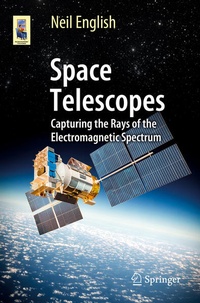
Space Telescopes
Capturing the Rays of the Electromagnetic Spectrum
Published on 17. November 2016
Book
Paperback/Softback
XII, 312 pages
978-3-319-27812-4 (ISBN)
Unfortunately, price unknown
Available (delivery time upon request)
Not available
Description
Space telescopes are among humankind's greatest scientific achievements of the last fifty years. This book describes the instruments themselves and what they were designed to discover about the Solar System and distant stars. Exactly how these telescopes were built and launched and the data they provided is explored.
Only certain kinds of radiation can penetrate our planet's atmosphere, which limits what we can observe. But with space telescopes all this changed. We now have the means to "see" beyond Earth using ultraviolet, microwave, and infrared rays, X-rays and gamma rays.
In this book we meet the pioneers and the telescopes that were built around their ideas. This book looks at space telescopes not simply chronologically but also in order of the electromagnetic spectrum, making it possible to understand better why they were made.
Only certain kinds of radiation can penetrate our planet's atmosphere, which limits what we can observe. But with space telescopes all this changed. We now have the means to "see" beyond Earth using ultraviolet, microwave, and infrared rays, X-rays and gamma rays.
In this book we meet the pioneers and the telescopes that were built around their ideas. This book looks at space telescopes not simply chronologically but also in order of the electromagnetic spectrum, making it possible to understand better why they were made.
Reviews / Votes
"English, a Fellow of the Royal Astronomical Society, takes the reader through an exploration of the discovery of the various spectrums, compositely the electromagnetic spectrum, which is used to study the cosmos through telescopes. ... this book is filled with fun information about the science and technology utilized to study the past and prepare for the future. Summing Up: Recommended. All readers." (R. I. Saltz, Choice, Vol. 57 (11), July, 2017)"English, a Fellow of the Royal Astronomical Society, takes the reader through an exploration of the discovery of the various spectrums, compositely the electromagnetic spectrum, which is used to study the cosmos through telescopes. ... this book is filled with fun information about the science and technology utilized to study the past and prepare for the future. Summing Up: Recommended. All readers." (R. I. Saltz, Choice, Vol. 57 (11), July, 2017)
More details
Product info
Book
Series
Edition
1st ed. 2017
Language
English
Place of publication
Cham
Switzerland
Publishing group
Springer International Publishing
Target group
Professional and scholarly
Popular/general
Illustrations
15
50 farbige Tabellen, 88 farbige Abbildungen, 15 s/w Abbildungen
XII, 312 p. 103 illus., 88 illus. in color.
Dimensions
Height: 235 mm
Width: 155 mm
Thickness: 18 mm
Weight
493 gr
ISBN-13
978-3-319-27812-4 (9783319278124)
DOI
10.1007/978-3-319-27814-8
Schweitzer Classification
Other editions
Additional editions
E-Book
11/2016
Springer
€42.79
Available for download
Person
Dr. Neil English is an Irish citizen with a BSc in Physics & Astronomy, and also a PhD in Biochemistry. He is a Fellow of the Royal Astronomical Society, and a regular contributor to Astronomy Now (the UK's major astronomy magazine), as well as to Ireland's Astronomy & Space. Dr. English's astronomical images have been published in various magazines and journals, including a full page in the June 2006 issue of Astronomy. Dr. English has, and continues to, make contributions to Cloudy Nights in the form of several detailed telescope reviews. He is the author of Guide to Mars (Pole Star Publications, 2003) and he has three books published by Springer: Choosing and Using a Refracting Telescope (2010), Choosing and Using a Dobsonian Telescope (2011), Classic Telescopes (2012). His fourth book with Springer is Grab 'n' Go Astronomy (2014). Dr. English currently has (among other instruments) a large 12-inch Dobsonian which he uses on the darkest, steadiest nights at his home in rural Scotland.