

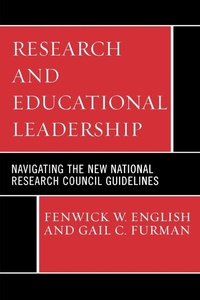
Research and Educational Leadership
Navigating the New National Research Council Guidelines
Published on 18. October 2006
Book
Paperback/Softback
192 pages
978-1-57886-551-2 (ISBN)
Description
Research and Educational Leadership is the first book to directly address the implications of the National Research Council's (NRC's) Scientific Research in Education (2002) in the fields of educational leadership and school administration. This text points out the strengths and weaknesses of the NRC's recommendations and specifically identifies areas that are not likely to lead to either theoretical or practical advances in practice or new knowledge if the NRC's guidelines become dominant in determining the value of research. Research and Educational Leadership is an invaluable tool in rethinking how research is conducted in educational leadership and how public and private funding agencies should view research proposals for improving leadership practices in schools. It is also a key resource for teaching researchers to think more deeply about school leadership as they engage in dissertation research. Practitioners will also find the work an important reference in understanding what kinds of research are likely to promote improved comprehension of leadership practices and social justice.
Reviews / Votes
As a new wave of logical positivism gains momentum in the United States educational system, it is important to reflect on the lessons of history and to understand contemporary critiques of how 'scientific' research can-and cannot-inform educators' work in schools. The chapters in this book span an impressive array of perspectives and will help researchers and practitioners alike realize the limitations and strengths of scientific research on educational leadership. -- Jeffrey Brooks, Florida State University Amid criticisms that research in educational leadership has lacked rigor and practicality, this book clearly and evocatively demonstrates that this complex area of inquiry involves more than merely determining what, for example, is the best reading program to be employed in a given school or class. Rather, by acknowledging that the study of educational leadership involves the full range of human art and inquiry, including, but not limited to, theory, philosophy, law, and curriculum, to name a few, the authors challenge educational researchers (and consumers) to come to grips with some of the quintessential questions that vex the professional lives of academicians and practitioners who are interested in improving the quality of leadership for our schools. -- Charles J. Russo The seven chapters raise a number of pertinent issues about relevance and rigor that deserve the attention of all researchers...Highly recommended. * Choice Reviews * I commend each of the authors in this book for stimulating the dialogue in our profession on the relevance and rigor of educational research. They all have contributed to that continuing purpose of UCEA to inform and improve research that benefits all students, families, and educators. -- Gary M. Crow, UCEA Executive Committee member and chair of the Department of Educational Leadership and Policy, University of UtahMore details
Language
English
Place of publication
United States
Publishing group
Bloomsbury Publishing Plc
Dimensions
Height: 229 mm
Width: 152 mm
Thickness: 11 mm
Weight
290 gr
ISBN-13
978-1-57886-551-2 (9781578865512)
Copyright in bibliographic data and cover images is held by Nielsen Book Services Limited or by the publishers or by their respective licensors: all rights reserved.
Schweitzer Classification
Persons
Fenwick W. English is the R. Wendell Eaves Distinguished Professor of Educational Leadership in the School of Education at the University of North Carolina at Chapel Hill. He is a former public superintendent of schools, middle school principal, classroom teacher, and author or co-author of more than twenty books in educational leadership.
Gail C. Furman is professor and program coordinator of the Educational Leadership Program at Washington State University and a past president of the University Council for Educational Administration. She has published numerous books and articles on her research emphases-moral leadership, community, and ecojustice.
Gail C. Furman is professor and program coordinator of the Educational Leadership Program at Washington State University and a past president of the University Council for Educational Administration. She has published numerous books and articles on her research emphases-moral leadership, community, and ecojustice.
Content
Chapter 1 Foreword
Chapter 2 Introduction
Chapter 3 The NRC's Scientific Research in Education: It Isn't Even Wrong!
Chapter 4 Scientific Research in Education: Implications for Culturally Sensitive Research Frameworks in Educational Leadership
Chapter 5 The Political Paradoxes of Scientific Research in Education
Chapter 6 "Scientific" Research and the New Narrative for Educational Leadership
Chapter 7 What's a Researcher to Do? Insights for "Post-Anything" Researchers
Chapter 8 Standards for Research(er) Integrity in Educational Leadership: Implications for Current and Future Researchers
Chapter 9 Research on Educational Leadership: Knowledge We Need for the World We Live In
Chapter 2 Introduction
Chapter 3 The NRC's Scientific Research in Education: It Isn't Even Wrong!
Chapter 4 Scientific Research in Education: Implications for Culturally Sensitive Research Frameworks in Educational Leadership
Chapter 5 The Political Paradoxes of Scientific Research in Education
Chapter 6 "Scientific" Research and the New Narrative for Educational Leadership
Chapter 7 What's a Researcher to Do? Insights for "Post-Anything" Researchers
Chapter 8 Standards for Research(er) Integrity in Educational Leadership: Implications for Current and Future Researchers
Chapter 9 Research on Educational Leadership: Knowledge We Need for the World We Live In