

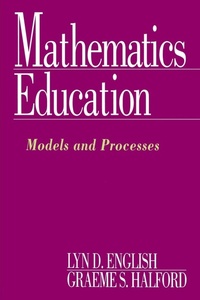
Mathematics Education
Models and Processes
1st Edition
Published on 1. July 1995
Book
Paperback/Softback
372 pages
978-0-8058-1458-3 (ISBN)
Description
To define better techniques of mathematics education, this book combines a knowledge of cognitive science with mathematics curriculum theory and research. The concept of the human reasoning process has been changed fundamentally by cognitive science in the last two decades. The role of memory retrieval, domain-specific and domain-general skills, analogy, and mental models is better understood now than previously. The authors believe that cognitive science provides the most accurate account thus far of the actual processes that people use in mathematics and offers the best potential for genuine increases in efficiency. As such, they suggest that a cognitive science approach enables constructivist ideas to be analyzed and further developed in the search for greater understanding of children's mathematical learning.
Not simply an application of cognitive science, however, this book provides a new perspective on mathematics education by examining the nature of mathematical concepts and processes, how and why they are taught, why certain approaches appear more effective than others, and how children might be assisted to become more mathematically powerful. The authors use recent theories of analogy and knowledge representation -- combined with research on teaching practice -- to find ways of helping children form links and correspondences between different concepts, so as to overcome problems associated with fragmented knowledge. In so doing, they have capitalized on new insights into the values and limitations of using concrete teaching aids which can be analyzed in terms of analogy theory.
In addition to addressing the role of understanding, the authors have analyzed skill acquisition models in terms of their implications for the development of mathematical competence. They place strong emphasis on the development of students' mathematical reasoning and problem solving skills to promote flexible use of knowledge. The book further demonstrates how children have a number of general problem solving skills at their disposal which they can apply independently to the solution of novel problems, resulting in the enhancement of their mathematical knowledge.
Not simply an application of cognitive science, however, this book provides a new perspective on mathematics education by examining the nature of mathematical concepts and processes, how and why they are taught, why certain approaches appear more effective than others, and how children might be assisted to become more mathematically powerful. The authors use recent theories of analogy and knowledge representation -- combined with research on teaching practice -- to find ways of helping children form links and correspondences between different concepts, so as to overcome problems associated with fragmented knowledge. In so doing, they have capitalized on new insights into the values and limitations of using concrete teaching aids which can be analyzed in terms of analogy theory.
In addition to addressing the role of understanding, the authors have analyzed skill acquisition models in terms of their implications for the development of mathematical competence. They place strong emphasis on the development of students' mathematical reasoning and problem solving skills to promote flexible use of knowledge. The book further demonstrates how children have a number of general problem solving skills at their disposal which they can apply independently to the solution of novel problems, resulting in the enhancement of their mathematical knowledge.
Reviews / Votes
"Traces history of the psychology of mathematics education, and summarizes principles of cognition and cognitive development....Valuable reference for mathematics educators and graduate students."-The American Mathematical Monthly
"...This is a valuable book in what it offers and deserves a place in the library of psychology, mathematics and education departments."
-British Journal of Educational Psychology
More details
Language
English
Place of publication
New York
United States
Publishing group
Taylor & Francis Inc
Target group
College/higher education
Professional and scholarly
Dimensions
Height: 229 mm
Width: 152 mm
Thickness: 20 mm
Weight
541 gr
ISBN-13
978-0-8058-1458-3 (9780805814583)
Copyright in bibliographic data and cover images is held by Nielsen Book Services Limited or by the publishers or by their respective licensors: all rights reserved.
Schweitzer Classification
Other editions
Additional editions
E-Book
12/2012
1st Edition
Routledge
€69.99
Available for download
E-Book
12/2012
1st Edition
Routledge
€69.99
Available for download
Book
07/1995
1st Edition
Routledge
€207.30
Shipment within 10-20 days
Persons
Lyn D. English, Graeme S. Halford
Content
Contents: Preface. Cognitive Psychology and Mathematics Education. Cognition and Cognitive Development. Cognitive Models and Processes in Mathematics Education. Numerical Models and Processes. Elementary Computational Models and Processes: Addition and Subtraction. Elementary Computational Models and Processes: Multiplication and Division. Advanced Computational Models and Processes. Problem Solving, Problem Posing, and Mathematical Thinking. Reflections and Recommendations.