

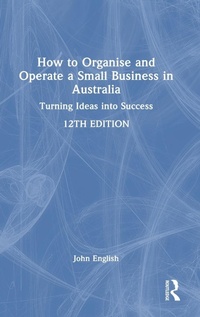
How to Organise and Operate a Small Business in Australia
Turning Ideas into Success
12th Edition
Published on 24. May 2024
Book
Hardback
288 pages
978-1-032-67660-9 (ISBN)
Description
You have an idea for a business, but you're not sure where to begin. Or perhaps you have made a start, but you're not sure what to do next. It's a common dilemma shared by everyone who has been down the same path. Where can I go for help? What are my legal obligations? How do I start making sales? How can I use digital marketing? How do I organise my operations? What's involved in employing staff? How do I handle my finances?
How to Organise and Operate a Small Business in Australia is your hands-on guide to running your own business. This new 12th edition contains information, skills, and ideas that are up to date, easy to understand, and simple to use. It reflects fundamental changes that have taken place as a result of the pandemic and the surge in small business digital technology. A feature of this new edition is a series of reflective exercises designed to help you evaluate your business ideas for their commercial potential.
Used by tens of thousands of Australians to become self-employed, this new 12th edition is the most comprehensive small business handbook in Australia. An essential read for anyone who wants to have a business of their own.
How to Organise and Operate a Small Business in Australia is your hands-on guide to running your own business. This new 12th edition contains information, skills, and ideas that are up to date, easy to understand, and simple to use. It reflects fundamental changes that have taken place as a result of the pandemic and the surge in small business digital technology. A feature of this new edition is a series of reflective exercises designed to help you evaluate your business ideas for their commercial potential.
Used by tens of thousands of Australians to become self-employed, this new 12th edition is the most comprehensive small business handbook in Australia. An essential read for anyone who wants to have a business of their own.
More details
Edition
12th edition
Language
English
Place of publication
London
United Kingdom
Publishing group
Taylor & Francis Ltd
Target group
College/higher education
Professional and scholarly
Further/Vocational Education and Professional Practice & Development
Illustrations
5 s/w Zeichnungen, 40 s/w Tabellen, 5 s/w Abbildungen
40 Tables, black and white; 5 Line drawings, black and white; 5 Illustrations, black and white
Dimensions
Height: 240 mm
Width: 161 mm
Thickness: 21 mm
Weight
614 gr
ISBN-13
978-1-032-67660-9 (9781032676609)
Copyright in bibliographic data and cover images is held by Nielsen Book Services Limited or by the publishers or by their respective licensors: all rights reserved.
Schweitzer Classification
Other editions
Additional editions
E-Book
05/2024
12th Edition
Routledge
€45.99
Available for download
E-Book
05/2024
12th Edition
Routledge
€45.99
Available for download
Book
05/2024
12th Edition
Routledge
€52.30
Shipment within 10-20 days
Previous edition
John W. English
How to Organise & Operate a Small Business in Australia
How to turn ideas into success - from Australia's leading small business writer
Book
03/2021
11th Edition
Routledge
€167.13
Article exhausted; check for reprint
Person
John English brings together a lifetime of business insight as an accountant, entrepreneur, and associate professor in entrepreneurship at the University of Tasmania. The simplicity and clarity of this book is a reflection of the author's ability to blend his academic expertise with years of practical first-hand business experience.
Content
INTRODUCTION
PART A PREPARING FOR SELF-EMPLOYMENT
1. The self-employment decision
The power of being small. Diversity of small businesses. Pros and cons of self-employment. Personal characteristics and success. Management skills and experience. Taking the plunge. Risk of failure. Summary.
2. Information and assistance
Choosing and an accountant. Choosing a solicitor. Finding a mentor. Business Enterprise Centre. Trade association. Australian Institute of Company Directors. Networking. State and territory small business agencies. Commonwealth government. Training programs. Summary.
Reflective exercise: Why do I want to be self-employed?
PART B GETTING STARTED
3. Pathways into business
Parallel opportunities. New market opportunities. New product and service opportunities. Buying a Business. Buying a franchise. Starting from scratch. Summary.
4. Start-up nuts and bolts
Legal structure. What's in a name? Business Registration Service. Licences and permits. Insurance. Summary.
5. Business plan
Myths and reality of planning. Putting your plan on paper. Sample business plan. Adapting to change. Summary.
Reflective exercise: Evaluating the Risks
PART C MARKETING PLAN
6. Marketing strategy
Understanding your customers. Customer information. Positioning your business. Products and services. Distribution. Promotion. Pricing. Marketing mix. Summary.
7. Traditional marketing
Direct marketing. Media advertising. Writing advertising copy. Publicity. Sponsorship. Personal selling. Summary.
8. Digital marketing
What is digital marketing? Do I need a website? Search engines and directories. Email marketing. Online promotion. Social media. Mobile marketing. Getting help. Summary.
Reflective exercise: Capturing the Target Market
PART D OPERATIONS PLAN
9. Operating practices
Service operations. Retail operations. Online operations. Manufacturing operations. Summary.
10. Location and layout
Temporary premises. Home-based business. Retail premises. Service businesses. Manufacturing premises. Local government regulations. Negotiating a lease. Summary.
11. Employing staff
Legal framework. Designing a job. Hiring new staff. Motivation and performance. Staff turnover. Summary.
Reflective exercise: Creating a Smooth Operation
PART E FINANCIAL PLAN
12. Financial information
Paper trail. Accounting system. Balance sheet. Income statement. Financial ratios. Monitoring performance. Summary.
13. Managing liquidity
Operating cycle. Managing accounts receivable. Managing inventory. Managing accounts payable. Managing cash flow. Overcoming problems. Summary.
14. Managing profitability
Cost structure. Contribution margin. Break-even point. Product and service profitability. Customer profitability. Market channel profitability. Monitoring costs. Summary.
15. Financing and taxation
Borrowing money. Leasing. Equity capital. Government grants. Australian taxation system. Summary.
Reflective exercise: Financial Forecasts
Appendix: Assessing Commercial Potential
PART A PREPARING FOR SELF-EMPLOYMENT
1. The self-employment decision
The power of being small. Diversity of small businesses. Pros and cons of self-employment. Personal characteristics and success. Management skills and experience. Taking the plunge. Risk of failure. Summary.
2. Information and assistance
Choosing and an accountant. Choosing a solicitor. Finding a mentor. Business Enterprise Centre. Trade association. Australian Institute of Company Directors. Networking. State and territory small business agencies. Commonwealth government. Training programs. Summary.
Reflective exercise: Why do I want to be self-employed?
PART B GETTING STARTED
3. Pathways into business
Parallel opportunities. New market opportunities. New product and service opportunities. Buying a Business. Buying a franchise. Starting from scratch. Summary.
4. Start-up nuts and bolts
Legal structure. What's in a name? Business Registration Service. Licences and permits. Insurance. Summary.
5. Business plan
Myths and reality of planning. Putting your plan on paper. Sample business plan. Adapting to change. Summary.
Reflective exercise: Evaluating the Risks
PART C MARKETING PLAN
6. Marketing strategy
Understanding your customers. Customer information. Positioning your business. Products and services. Distribution. Promotion. Pricing. Marketing mix. Summary.
7. Traditional marketing
Direct marketing. Media advertising. Writing advertising copy. Publicity. Sponsorship. Personal selling. Summary.
8. Digital marketing
What is digital marketing? Do I need a website? Search engines and directories. Email marketing. Online promotion. Social media. Mobile marketing. Getting help. Summary.
Reflective exercise: Capturing the Target Market
PART D OPERATIONS PLAN
9. Operating practices
Service operations. Retail operations. Online operations. Manufacturing operations. Summary.
10. Location and layout
Temporary premises. Home-based business. Retail premises. Service businesses. Manufacturing premises. Local government regulations. Negotiating a lease. Summary.
11. Employing staff
Legal framework. Designing a job. Hiring new staff. Motivation and performance. Staff turnover. Summary.
Reflective exercise: Creating a Smooth Operation
PART E FINANCIAL PLAN
12. Financial information
Paper trail. Accounting system. Balance sheet. Income statement. Financial ratios. Monitoring performance. Summary.
13. Managing liquidity
Operating cycle. Managing accounts receivable. Managing inventory. Managing accounts payable. Managing cash flow. Overcoming problems. Summary.
14. Managing profitability
Cost structure. Contribution margin. Break-even point. Product and service profitability. Customer profitability. Market channel profitability. Monitoring costs. Summary.
15. Financing and taxation
Borrowing money. Leasing. Equity capital. Government grants. Australian taxation system. Summary.
Reflective exercise: Financial Forecasts
Appendix: Assessing Commercial Potential