

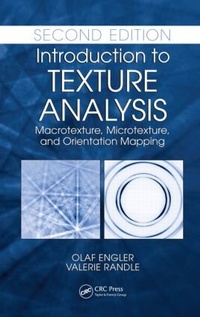
Introduction to Texture Analysis
Macrotexture, Microtexture, and Orientation Mapping, Second Edition
2nd Edition
Published on 16. November 2009
Book
Paperback/Softback
488 pages
978-1-4200-6365-3 (ISBN)
Description
The first edition of Introduction to Texture Analysis: Macrotexture, Microtexture, and Orientation Mapping broke new ground by collating seventy years worth of research in a convenient single-source format. Reflecting emerging methods and the evolution of the field, the second edition continues to provide comprehensive coverage of the concepts, practices, and applications of techniques used to determine and characterize texture.
Providing a clear focus on scientific principles, this reference keeps mathematics to a minimum in covering both traditional macrotexture analysis and more modern electron-microscopy-based microtexture analysis. The authors integrate the two techniques and address the subsequent need for a more detailed explanation of philosophy, practice, and analysis associated with texture analysis. The book is organized into three sections:
Fundamental Issues addresses terminology associated with orientations and texture, in addition to their representation. It also covers the diffraction of radiation, a phenomenon that is the basis for almost all texture analysis.
Macrotexture Analysis covers data acquisition, as well as representation and evaluation related to the well-established methods of macrotexture analysis.
Microtexture Analysis provides experimental details of the transmission or scanning electron microscope-based techniques for microtexture analysis. It also describes how microtexture data are evaluated and represented and explores the innovative topics of orientation microscopy and mapping, and advanced issues concerning crystallographic aspects of interfaces and connectivity.
Completely revised and updated, this second edition of a bestseller is a rare introductory-level guide to texture analysis. It illustrates approaches to orientation measurement and interpretation and elucidates the fundamental principles on which measurements are based. This book is an ideal tool to help you develop a working understanding of the practice and applications of texture.
Providing a clear focus on scientific principles, this reference keeps mathematics to a minimum in covering both traditional macrotexture analysis and more modern electron-microscopy-based microtexture analysis. The authors integrate the two techniques and address the subsequent need for a more detailed explanation of philosophy, practice, and analysis associated with texture analysis. The book is organized into three sections:
Fundamental Issues addresses terminology associated with orientations and texture, in addition to their representation. It also covers the diffraction of radiation, a phenomenon that is the basis for almost all texture analysis.
Macrotexture Analysis covers data acquisition, as well as representation and evaluation related to the well-established methods of macrotexture analysis.
Microtexture Analysis provides experimental details of the transmission or scanning electron microscope-based techniques for microtexture analysis. It also describes how microtexture data are evaluated and represented and explores the innovative topics of orientation microscopy and mapping, and advanced issues concerning crystallographic aspects of interfaces and connectivity.
Completely revised and updated, this second edition of a bestseller is a rare introductory-level guide to texture analysis. It illustrates approaches to orientation measurement and interpretation and elucidates the fundamental principles on which measurements are based. This book is an ideal tool to help you develop a working understanding of the practice and applications of texture.
More details
Edition
2nd edition
Language
English
Place of publication
Bosa Roca
United States
Publishing group
Taylor & Francis Inc
Target group
Professional and scholarly
Professional
Product notice
Paperback (UK-B)
Illustrations
199 s/w Abbildungen, 20 s/w Tabellen
20 Tables, black and white; 199 Illustrations, black and white
Dimensions
Height: 234 mm
Width: 156 mm
Weight
703 gr
ISBN-13
978-1-4200-6365-3 (9781420063653)
Copyright in bibliographic data and cover images is held by Nielsen Book Services Limited or by the publishers or by their respective licensors: all rights reserved.
Schweitzer Classification
Other editions
New editions
Olaf Engler | Stefan Zaefferer | Valerie Randle
Introduction to Texture Analysis
Macrotexture, Microtexture, and Orientation Mapping
Book
02/2024
3rd Edition
CRC Press
€217.10
Shipment within 10-20 days
Additional editions
Olaf Engler | Valerie Randle
Introduction to Texture Analysis
Macrotexture, Microtexture, and Orientation Mapping, Second Edition
Book
07/2017
2nd Edition
CRC Press
€267.41
Article exhausted; check for reprint
Persons
Olaf Engler is senior scientist of metallurgy at the Research and Development Center of Hydro Aluminium in Bonn, Germany. Prior to that, he was at the University of Technology in Aachen, Germany, and the Materials Science and Technology Division of Los Alamos National Laboratory in the United States. Since 2004, he has also been an adjunct professor for Texture and Crystal Plasticity at the NTNU Trondheim, Norway, and a member of the international committee of the International Conference on Texture of Materials (ICOTOM). Engler has more than 20 years of experience in analysis, interpretation, and modeling of the development of microstructure and texture during the thermomechanical processing of metallic materials and control of the resulting materials properties.
Valerie Randle has been eminent in the field of electron backscatter diffraction for more than 20 years. Her other main research interest is grain boundary engineering in metals and alloys. She has written more than 300 scientific publications on these research topics, including five textbooks. Randle is a past Welsh Woman of the Year and recipient of the Institute of Materials' Rosenhain Medal. Currently, she is the senior professor in the Materials Research Centre at Swansea University in Wales, United Kingdom.
Valerie Randle has been eminent in the field of electron backscatter diffraction for more than 20 years. Her other main research interest is grain boundary engineering in metals and alloys. She has written more than 300 scientific publications on these research topics, including five textbooks. Randle is a past Welsh Woman of the Year and recipient of the Institute of Materials' Rosenhain Medal. Currently, she is the senior professor in the Materials Research Centre at Swansea University in Wales, United Kingdom.
Content
Part I: Fundamental Issues
Introduction. Descriptors of Orientation. Application of Diffraction to Texture Analysis.
Part II: Macrotexture Analysis
Macrotexture Measurements. Evaluation and Representation of Macrotexture Data.
Part III: Microtexture Analysis
The Kikuchi Diffraction Pattern. Scanning Electron Microscopy-Based Techniques. Transmission Electron Microscopy-Based Techniques. Evaluation and Representation of Microtexture Data. Orientation Microscopy and Orientation Mapping. Crystallographic Analysis of Interfaces, Surfaces, and Connectivity. Synchrotron Radiation, Nondiffraction Techniques, and Comparisons between Methods.
Introduction. Descriptors of Orientation. Application of Diffraction to Texture Analysis.
Part II: Macrotexture Analysis
Macrotexture Measurements. Evaluation and Representation of Macrotexture Data.
Part III: Microtexture Analysis
The Kikuchi Diffraction Pattern. Scanning Electron Microscopy-Based Techniques. Transmission Electron Microscopy-Based Techniques. Evaluation and Representation of Microtexture Data. Orientation Microscopy and Orientation Mapping. Crystallographic Analysis of Interfaces, Surfaces, and Connectivity. Synchrotron Radiation, Nondiffraction Techniques, and Comparisons between Methods.