

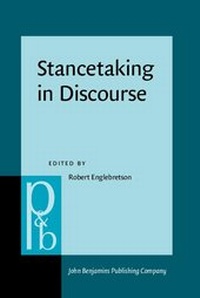
Stancetaking in Discourse
Subjectivity, evaluation, interaction
Published on 25. October 2007
Book
Hardback
323 pages
978-90-272-5408-5 (ISBN)
Description
This volume contributes to the burgeoning field of research on stance by offering a variety of studies based in natural discourse. These collected papers explore the situated, pragmatic, and interactional character of stancetaking, and present new models and conceptions of stance to spark future research. Central to the volume is the claim that stancetaking encompasses five general principles: it involves physical, attitudinal and/or moral positioning; it is a public action; it is inherently dialogic, interactional, and sequential; it indexes broader sociocultural contexts; and it is consequential to the interactants. Each paper explores one or more of these dimensions of stance from perspectives including interactional linguistics and conversation analysis, corpus linguistics, language description, discourse analysis, and sociocultural linguistics. Research languages include conversational American English, colloquial Indonesian, and Finnish. The understanding of stance that emerges is heterogeneous and variegated, and always intertwined with the pragmatic and social aspects of human conduct.
More details
Series
Language
English
Place of publication
Amsterdam
Netherlands
Target group
Professional and scholarly
Dimensions
Height: 245 mm
Width: 164 mm
Weight
740 gr
ISBN-13
978-90-272-5408-5 (9789027254085)
Copyright in bibliographic data and cover images is held by Nielsen Book Services Limited or by the publishers or by their respective licensors: all rights reserved.
Schweitzer Classification
Other editions
Additional editions
E-Book
10/2007
1st Edition
John Benjamins Publishing Company
€130.99
Available for download
Person
Content
1. Acknowledgements; 2. Stancetaking in discourse: An introduction (by Englebretson, Robert); 3. Using a corpus to investigate stance quantitatively and qualitatively (by Hunston, Susan); 4. Linking identity and dialect through stancetaking (by Johnstone, Barbara); 5. Grammatical resources for social purposes: Some aspects of stancetaking in colloquial Indonesian conversation (by Englebretson, Robert); 6. Subjective and intersubjective uses of generalizations in English conversations (by Scheibman, Joanne); 7. The stance triangle (by Du Bois, John W.); 8. The role of I guess in conversational stancetaking (by Karkkainen, Elise); 9. Stance markers in spoken Finnish: Minun mielesta and minusta in assessments (by Rauniomaa, Mirka); 10. Stancetaking as an interactional activity: Challenging the prior speaker (by Keisanen, Tiina); 11. Positioning and alignment as activities of stancetaking in news interviews (by Haddington, Pentti); 12. Name index; 13. Subject index