

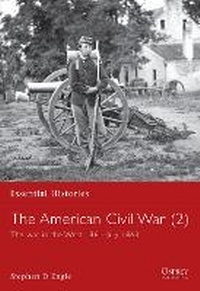
The American Civil War (2)
The war in the West 1861-July 1863
Published on 25. September 2001
Book
Paperback/Softback
96 pages
978-1-84176-240-1 (ISBN)
Description
The American Civil War's vast Western Theater witnessed enormously important military campaigning during the period 1861 - 1863. This book, the third in a four-book series, examines the geographical, logistical, and strategic factors that shaped fighting in this theater of the American Civil War, as well as assessing officers who played key roles. The story is told of Ulysses S Grant's important capture of rebel positions before marching south to win the battle of Shiloh, as well that of Albert Sidney Johnston, the pride of the Confederacy, who received a mortal wound at Shiloh. A facinating study of men and motives in the American Civil War.
More details
Series
Language
English
Place of publication
United Kingdom
Publishing group
Bloomsbury Publishing PLC
Illustrations
41 b/w; 15 col
Dimensions
Height: 248 mm
Width: 170 mm
Thickness: 7 mm
Weight
332 gr
ISBN-13
978-1-84176-240-1 (9781841762401)
Copyright in bibliographic data and cover images is held by Nielsen Book Services Limited or by the publishers or by their respective licensors: all rights reserved.
Schweitzer Classification
Person
Stephen D. Engle is professor of history at Florida Atlantic University. He is the author of many books and articles on the Civil War, particularly the war in the western theater, including biographies of German-American Franz Sigel (Yankee Dutchman, 1993, reprint 1999) and Union General Don Carlos Buell (Most Promising of All, 1999). His forthcoming work. Struggle for the Heartland, a volume in the "Great Campaigns of the Civil War," focuses on the early phase of the Civil War in the West. He has lectured both in the United States and in Germany and is currently engaged in research for a book on Lincoln and the War Governors.
Content
Introduction and chronology; Background to War; Warring sides; The fighting; Portrait of a soldier; The world around war; Portrait of a civilian; How the period ended; Conclusion and consequences