

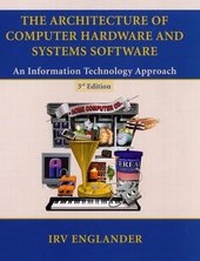
The Architecture of Computer Hardware and Systems Software
An Information Technology Approach
3rd Edition
Published on 20. January 2003
Book
Hardback
760 pages
978-0-471-07325-3 (ISBN)
Description
This title deals with the fundamental principles that will keep you on the cutting edge! Most computer architecture books are just too technical and complex. Focusing on specific technology, they often bypass the basics and are outdated as quickly as technology advances. Now, Irv Englander's gentle-but-thorough introduction to computer architecture and systems software provides just the right amount of technical detail you'll need to make successful decisions in your future career. The text covers all the basics in an accessible, easy-to-understand way. Organized in a form that parallels an actual computer system, entire sections are devoted to principles of data, hardware, and software, with computer interconnection, clustering, and networking integrated into the material to emphasize the importance of computer and system structure. Assuming only basic knowledge, these sections build up to an in-depth understanding of each topic and how they interrelate to make up a computer system. With this Third Edition's outstanding features, you'll be able to build a solid foundation for success on the job. All chapters have been thoroughly updated to reflect current technology.
It is revised with even clearer discussions of virtual storage, the operation of memory, and modern CPU architectures. Programming examples are written in a C++/Java - like pseudocode. It emphasizes the computer aspects of clustering and networking, rather than the data communication aspects. It provide an understanding of underlying, non-changing basics of computers, so that you can make knowledgeable decisions about systems. It introduces new technological concepts without overwhelming you with too much detail. Examples cover a broad spectrum of hardware and software systems, from personal computers to mainframes. It integrates discussions of hardware and software throughout, and explores the symbiosis between them.
It is revised with even clearer discussions of virtual storage, the operation of memory, and modern CPU architectures. Programming examples are written in a C++/Java - like pseudocode. It emphasizes the computer aspects of clustering and networking, rather than the data communication aspects. It provide an understanding of underlying, non-changing basics of computers, so that you can make knowledgeable decisions about systems. It introduces new technological concepts without overwhelming you with too much detail. Examples cover a broad spectrum of hardware and software systems, from personal computers to mainframes. It integrates discussions of hardware and software throughout, and explores the symbiosis between them.
More details
Edition
3rd Revised edition
Language
English
Place of publication
New York
United States
Publishing group
John Wiley and Sons Ltd
Target group
Professional and scholarly
Edition type
Revised edition
Illustrations
Illustrations
Dimensions
Height: 245 mm
Width: 197 mm
Thickness: 33 mm
Weight
1304 gr
ISBN-13
978-0-471-07325-3 (9780471073253)
Copyright in bibliographic data and cover images is held by Nielsen Book Services Limited or by the publishers or by their respective licensors: all rights reserved.
Schweitzer Classification
Other editions
New editions
Irv Englander
The Architecture of Computer Hardware and System Software
An Information Technology Approach
Book
04/2009
4th Edition
Wiley
€49.90
Article exhausted; check for reprint
Previous edition
Irv Englander
The Architecture of Computer Hardware and Systems Software
An Information Technology Approach. International Edition
Book
03/2003
3rd Edition
Wiley
€49.90
Withdrawn from sale
Person
Dr. Irv Englander has been involved in many different aspects of the computing field for more than forty years. He has designed logic circuits, developed integrated circuits, developed computer architectures, designed computer-controlled systems, designed operating systems developed application software, created the initial system design for a large water monitoring system, performed software auditing and verification of critical control software, and developed and specified hardware components and application software as a consultant for business systems large and small. As an educator he has contributed papers and given workshops on end-user computing, e-commerce, and on computer architecture education in the IS curriculum. He was an invited contributor and reviewer for the IS-97 information systems curriculum/ He is actively involved in the application of new technology to information systems. Dr. Englander has a Ph.D. From MIT in computer Science. His doctoral thesis was based on the design of a large image processing software laboratory. At MIT he won the supervised Investors Award for outstanding teaching. He holds the rank of Professor of Computer Information Systems at Bentley college, where he has taught full-time for nearly twenty-five years.
Content
Preface.About the Author.PART ONE. AN OVERVIEW OF COMPUTER SYSTEMS.Chapter 1. Computer Systems.PART TWO. DATA IN THE COMPUTER.Chapter 2. Number Systems.Chapter 3. Data Formats.Chapter 4. Representing Integer Data.Chapter 5. Floating Point Numbers.PART THREE. COMPUTER ARCHITECTURE AND HARDWARE OPERATION.Chapter 6. The Little Man Computer.Chapter 7. The CPU and Memory.Chapter 8. CPU and Memory: Design, Implementation, and Enhancement.Chapter 9. Input/Output.Chapter 10. Computer Peripherals.Chapter 11. Modern Computer Systems, Clusters, and Networks.Chapter 12. Three System Examples.PART FOUR. THE SOFTWARE COMPONENT.Chapter 13. Operating Systems: An Overview.Chapter 14. The User View of Operating Systems.Chapter 15. The Internal Operating System.Chapter 16. File Management.Chapter 17. Programming Tools.Chapter 18. Three Operating Systems.Supplementary Chapter 1. An Introduction to Digital Computer Logic.Supplementary Chapter 2. Instruction Addressing Modes.Supplementary Chapter 3. Communication Channel Technology.Bibliography.Index.