

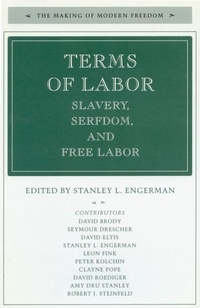
Terms of Labor
Slavery, Serfdom, and Free Labor
Published on 1. January 1999
Book
Hardback
364 pages
978-0-8047-3521-6 (ISBN)
Description
Throughout recorded history, labor to produce goods and services has been a central concern of society, and questions surrounding the terms of labor-the arrangements under which labor is made to produce and to divide its product with others-are of great significance for understanding the past and the emergence of the modern world.
For long periods, much of the world's labor could be considered under the coercive control of systems of slavery or of serfdom, with relatively few workers laboring under terms of freedom, however defined. Slavery and serfdom were systems that controlled not only the terms of labor, but also the more general issues of political freedom. The nine chapters in this volume deal with the general issues of the causes and consequences of the rise of so-called free labor in Europe, the United States, and the Caribbean over the past four to five centuries, and point to the many complications and paradoxical aspects of this change.
The topics covered are European beliefs that rejected the enslavement of other Europeans but permitted the slavery of Africans (David Eltis), British abolitionism and the impact of emancipation in the British West Indies (Seymour Drescher), the consequences of the end of Russian serfdom (Peter Kolchin), the definition and nature of free labor as seen by nineteenth-century American workers (Leon Fink), the effects of changing legal and economic concepts of free labor (Robert J. Steinfeld), the antebellum American use of the metaphor of slavery (David Roediger), female dependent labor in the aftermath of American emancipation (Amy Dru Stanley), the contrast between individual and group actions in attempting to benefit individual laborers (David Brody), and the link between arguments concerning free labor and the actual outcomes for laborers in nineteenth-century America (Clayne Pope).
For long periods, much of the world's labor could be considered under the coercive control of systems of slavery or of serfdom, with relatively few workers laboring under terms of freedom, however defined. Slavery and serfdom were systems that controlled not only the terms of labor, but also the more general issues of political freedom. The nine chapters in this volume deal with the general issues of the causes and consequences of the rise of so-called free labor in Europe, the United States, and the Caribbean over the past four to five centuries, and point to the many complications and paradoxical aspects of this change.
The topics covered are European beliefs that rejected the enslavement of other Europeans but permitted the slavery of Africans (David Eltis), British abolitionism and the impact of emancipation in the British West Indies (Seymour Drescher), the consequences of the end of Russian serfdom (Peter Kolchin), the definition and nature of free labor as seen by nineteenth-century American workers (Leon Fink), the effects of changing legal and economic concepts of free labor (Robert J. Steinfeld), the antebellum American use of the metaphor of slavery (David Roediger), female dependent labor in the aftermath of American emancipation (Amy Dru Stanley), the contrast between individual and group actions in attempting to benefit individual laborers (David Brody), and the link between arguments concerning free labor and the actual outcomes for laborers in nineteenth-century America (Clayne Pope).
More details
Series
Edition
New edition
Language
English
Place of publication
Palo Alto
United States
Target group
College/higher education
Professional and scholarly
Edition type
New edition
Product notice
Cloth
Dimensions
Height: 235 mm
Width: 162 mm
Thickness: 28 mm
Weight
717 gr
ISBN-13
978-0-8047-3521-6 (9780804735216)
Copyright in bibliographic data and cover images is held by Nielsen Book Services Limited or by the publishers or by their respective licensors: all rights reserved.
Schweitzer Classification
Person
Stanley L. Engerman is John H. Munro Professor of Economics and Professor of History at the University of Rochester. He is perhaps best known for the influential Time on the Cross: The Economics of American Negro Slavery, which he wrote with Robert W. Fogel.
Content
Introduction Stanley L. Engerman 1. Slavery and freedom in the early modern world David Eltis 2. Free labor vs. slave labor: the British and Caribbean cases Seymour Drescher 3. After serfdom: Russian emancipation in comparative perspective Peter Kolchin 4. From autonomy to abundance: changing beliefs about the free labour system in nineteenth-century America Leon Fink 5. Changing legal conceptions of free labor Robert J. Steinfeld 6. Race, labor and gender in the languages of antebellum social protest David Roediger 7. 'We did not separate man and wife, but all had to work': freedom and dependence in the aftermath of slave emancipation Amy Dru Stanley 8. Free labor, law and American trade unionism David Brody 9. Social mobility, free labor, and the American dream Clayne Pope Notes Index.