

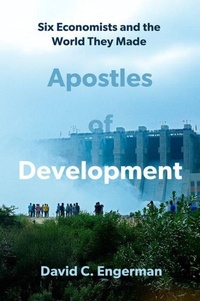
Apostles of Development
Six Economists and the World They Made
Published on 27. October 2025
Book
Hardback
576 pages
978-0-19-776620-0 (ISBN)
Description
Apostles of Development recounts the work of six individuals, all former classmates at Cambridge University, who helped make international development--the effort to reduce poverty and inequality around the world--into a juggernaut of the second half of the twentieth century. International development employed millions, affected billions, and spent trillions; it held the hopes of the former colonies to create an economic independence to match their newfound political one, and the plans of wealthy counties to build an enduring economic order.
The six Apostles in this book include some of South Asia's best-known names, like Nobel Laureate Amartya Sen and long-serving Indian Prime Minister Manmohan Singh, as well as leading academics (Jagdish Bhagwati) and key policy-makers in both national and international circles. Taken together, this group both reflected and shaped the growing enterprise of international development from the time they left Cambridge in the mid-1950s well into the 2010s.
For many years, the second half of the twentieth century was understood primarily through the lens of the Cold War. And yet, for the majority of the world, living in what was then called the Third World (and which is now called the Global South), development was a constant, while American-Soviet geopolitics only occasionally impinged upon their lives. And these six, as much as any other group, changed the way economists theorized development and aid officials practiced it. Their biographies, then, are the history of development.
Based on newly available archival documents from 10 countries, and on interviews with four of the subjects, the widows of the other two, and almost 100 of their colleagues, friends, classmates, and rivals, this book combines riveting personal accounts with a sweeping history of one of the enduring human activities of the late 20th century and early 21st centuries: creating a more prosperous and equitable world.
The six Apostles in this book include some of South Asia's best-known names, like Nobel Laureate Amartya Sen and long-serving Indian Prime Minister Manmohan Singh, as well as leading academics (Jagdish Bhagwati) and key policy-makers in both national and international circles. Taken together, this group both reflected and shaped the growing enterprise of international development from the time they left Cambridge in the mid-1950s well into the 2010s.
For many years, the second half of the twentieth century was understood primarily through the lens of the Cold War. And yet, for the majority of the world, living in what was then called the Third World (and which is now called the Global South), development was a constant, while American-Soviet geopolitics only occasionally impinged upon their lives. And these six, as much as any other group, changed the way economists theorized development and aid officials practiced it. Their biographies, then, are the history of development.
Based on newly available archival documents from 10 countries, and on interviews with four of the subjects, the widows of the other two, and almost 100 of their colleagues, friends, classmates, and rivals, this book combines riveting personal accounts with a sweeping history of one of the enduring human activities of the late 20th century and early 21st centuries: creating a more prosperous and equitable world.
Reviews / Votes
A splendid book - deft, intelligent, empathetic: bringing to life some of the most remarkable individuals and most important themes in the creation of the modern world. * Rory Stewart, Co-Host of The Rest Is Politics podcast and author of Politics on the Edge * Apostles of Development is a bracing, brilliant new history of international development, told through the interlocking biographies of six South Asian economists. David Engerman turns received wisdom on its head in his account of how ideas, individuals, and institutions from the Global South have reshaped the global economy-and the economics profession-with lasting consequences for our highly unequal world. This will be essential readings for historians, economists, and policymakers alike. * Sunil Amrith, Author of The Burning Earth and MacArthur Prize winner * David Engerman is one of the leading historians of development, not least because his perspective is always new. Apostles of Development does not disappoint. This beautifully wrought social history of ideas dissects the rich, world-changing thinking of a generation of South Asian economists. * Glenda Sluga, Professor of International History and Capitalism, EUI * This remarkable book is at once a group portrait of six economists from South Asia and a global history of the ideas, policies and practices of development that they espoused. Prodigiously researched and engagingly written, Apostles of Development is indispensable to understanding the postcolonial trajectories of India and Pakistan, Bangladesh and Sri Lanka * and indeed much of the Global South.Srinath Raghavan, Author of Indira Gandhi and the Years that Transformed India * This book narrates the life journey of six South Asians who studied economics in Cambridge (UK) in the 1950s-two remained in academia becoming superstars, three became profoundly influential policy makers and institution builders and one became a transformative Finance Minister and Prime Minister. The six stayed close friends all through and that is what makes their collective story, narrated by Engerman in his usual scholarly yet engaging style, all the more fascinating. * Jairam Ramesh, Member of Parliament and former Minister * Engerman, a historian, provides a fascinating portrait of six South Asian economists who had a tremendous impact on the theory and practice ofdevelopment economics. * Pratap Bhanu Mehta, Foreign Affairs * David Engerman's latest book is a thrill to read for any practitioner of development economics, but especially those who have studied or worked in South Asia... It's a masterful intellectual and policy history...[and] much more than a historical treatise; it appears at a time of great tension in the global development system over who sets priorities, how ideas travel, and what "development" should mean in an era of inequality, debt, and climate crisis. * Kalpana Kochhar, IMF Finance and Development *More details
Language
English
Place of publication
New York
United States
Target group
College/higher education
Dimensions
Height: 166 mm
Width: 245 mm
Thickness: 49 mm
Weight
880 gr
ISBN-13
978-0-19-776620-0 (9780197766200)
Copyright in bibliographic data and cover images is held by Nielsen Book Services Limited or by the publishers or by their respective licensors: all rights reserved.
Schweitzer Classification
Other editions
Additional editions
E-Book
07/2025
OUP eBook
€28.49
Available for download
E-Book
07/2025
OUP eBook
€28.49
Available for download
Person
David C. Engerman is Leitner International Interdisciplinary Professor of History and Global Affairs at Yale University. He is the author of The Price of Aid: The Economic Cold War in India, Know Your Enemy: The Rise and Fall of America's Soviet Experts (OUP, 2009), and Modernization from the Other Shore: American Intellectuals and the Romance of Russian Development and the editor or coeditor of multiple collections, including a volume of the Cambridge History of America and the World. Engerman served as elected president of the Society for Historians of American Foreign Relations in 2016.
Content
Introduction: Development as History and Biography PART I: Portraits of the Economists as Young Men, 1930s-1950s 1. Coming of Age in a New South Asia 2. The Problems of Keynesianism 3. Apostolic Ascension 4. Advancing Economics PART II: Growth and Its Discontents,1960-1970s 5. The Paradigm of Growth 6. Trading Alternatives 7. The Price of Growth 8. Unequal and Separate 9. Socialism Sweeps South Asia PART III: The Battle to Democratize the International Economy, 1970-1980s 10. Redefining Development at the World Bank
11. Fighting over the International Monetary Fund
12. A New International Economic Order? 13. Adjustment at Home and Abroad PART IV: Rightward Turn, 1980s
14. The Right of Reform 15. Reforms by Stealth 16. Southern Solidarities 17. Developing Humans PART V: Liberalization Theology, 1990s- 18. The Liberation of India 19. From Liberalization to Globalization 20. On Governance and Non-Governmentality
21. Of Markets, Memorials, and the Nobel Prize
22. Toward Inclusive Growth
Epilogue: Looking Back Note on Sources List of Archival and Electronic Sources Consulted Conversations and Correspondence
Illustration Credits Acknowledgments Abbreviations
Index
11. Fighting over the International Monetary Fund
12. A New International Economic Order? 13. Adjustment at Home and Abroad PART IV: Rightward Turn, 1980s
14. The Right of Reform 15. Reforms by Stealth 16. Southern Solidarities 17. Developing Humans PART V: Liberalization Theology, 1990s- 18. The Liberation of India 19. From Liberalization to Globalization 20. On Governance and Non-Governmentality
21. Of Markets, Memorials, and the Nobel Prize
22. Toward Inclusive Growth
Epilogue: Looking Back Note on Sources List of Archival and Electronic Sources Consulted Conversations and Correspondence
Illustration Credits Acknowledgments Abbreviations
Index