

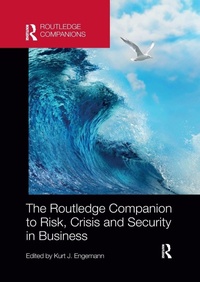
The Routledge Companion to Risk, Crisis and Security in Business
1st Edition
Published on 30. September 2020
Book
Paperback/Softback
484 pages
978-0-367-65612-6 (ISBN)
Description
Aware that a single crisis event can devastate their business, managers must be prepared for the worst from an expansive array of threats. The Routledge Companion to Risk, Crisis and Security in Business comprises a professional and scholarly collection of work in this critical field. Risks come in many varieties, and there is a growing concern for organizations to respond to the challenge. Businesses can be severely impacted by natural and man-made disasters including: floods, earthquakes, tsunami, environmental threats, terrorism, supply chain risks, pandemics, and white-collar crime. An organization's resilience is dependent not only on their own system security and infrastructure, but also on the wider infrastructure providing health and safety, utilities, transportation, and communication.
Developments in risk security and management knowledge offer a path towards resilience and recovery through effective leadership in crisis situations. The growing body of knowledge in research and methodologies is a basis for decisions to safeguard people and assets, and to ensure the survivability of an organization from a crisis. Not only can businesses become more secure through risk management, but an effective program can also facilitate innovation and afford new opportunities.
With chapters written by an international selection of leading experts, this book fills a crucial gap in our current knowledge of risk, crisis and security in business by exploring a broad spectrum of topics in the field. Edited by a globally-recognized expert on risk, this book is a vital reference for researchers, professionals and students with an interest in current scholarship in this expanding discipline.
Developments in risk security and management knowledge offer a path towards resilience and recovery through effective leadership in crisis situations. The growing body of knowledge in research and methodologies is a basis for decisions to safeguard people and assets, and to ensure the survivability of an organization from a crisis. Not only can businesses become more secure through risk management, but an effective program can also facilitate innovation and afford new opportunities.
With chapters written by an international selection of leading experts, this book fills a crucial gap in our current knowledge of risk, crisis and security in business by exploring a broad spectrum of topics in the field. Edited by a globally-recognized expert on risk, this book is a vital reference for researchers, professionals and students with an interest in current scholarship in this expanding discipline.
Reviews / Votes
'The Editor, Professor Kurt Engemann, along with the effort of contributing authors, has created an important resource for scientists, practitioners and students by producing The Routledge Companion to Risk, Crisis and Security in Business. This quality book provides a thorough exploration of numerous significant issues and methods, not commonly covered in textbooks in this vital field.' - Terje Aven, PhD, Professor of Risk Analysis and Risk Management, University of Stavanger, Norway.'This book is a comprehensive and authoritative source of the state-of-the-art in risk, crisis and security, from both a conceptual and a practical perspective. It is a must-read for business leaders, policy analysts, technicians and academics who seek innovative approaches and solutions for this exponentially growing complex field.' - Giampiero E.G. Beroggi, PhD, Professor and Director Center for Business Innovation, University of Applied Sciences in Business Administration Zurich, Switzerland.
More details
Series
Language
English
Place of publication
London
United Kingdom
Publishing group
Taylor & Francis Ltd
Target group
College/higher education
Postgraduate
Dimensions
Height: 246 mm
Width: 174 mm
Thickness: 27 mm
Weight
885 gr
ISBN-13
978-0-367-65612-6 (9780367656126)
Copyright in bibliographic data and cover images is held by Nielsen Book Services Limited or by the publishers or by their respective licensors: all rights reserved.
Schweitzer Classification
Other editions
Additional editions
Kurt J. Engemann
The Routledge Companion to Risk, Crisis and Security in Business
E-Book
06/2018
1st Edition
Routledge
€78.99
Available for download
Kurt J. Engemann
The Routledge Companion to Risk, Crisis and Security in Business
E-Book
06/2018
1st Edition
Routledge
€78.99
Available for download
Kurt J. Engemann
The Routledge Companion to Risk, Crisis and Security in Business
Book
06/2018
1st Edition
Routledge
€349.44
Shipment within 10-20 days
Person
Kurt J. Engemann, PhD, is Professor of Information Systems and Director of the Center for Business Continuity and Risk Management, Iona College, USA.
Content
PART I, Developing, Implementing and Maintaining Risk Strategies
1. Developments in risk security, Kurt J. Engemann, 2. The evolution of risk management thinking in organizations, Phil Kelly, 3. Intuition and decision making for crisis situations, Holmes E. Miller, 4. Business continuity management organizations: the models of implementation, Wei Ning Zechariah Wong and Jianping Shi, 5. Knowledge in high reliability organizations: a review of interrelated perspectives, Krista N. Engemann
PART II, Natural and Man-Made Disasters
6. A retrospective account of the impacts of the 1960 Valdivia, Chile, earthquake and tsunami and the lack of business continuity planning, Benigno E. Aguirre, 7. What lurks beneath: deep supply chain risks, Yossi Sheffi, 8. Crisis leadership: a leader's new normal, Robert J. Darling and Stephen Young, 9. Internal investigations of white-collar crime, Petter Gottschalk, 10. Collapse or recovery after white-collar crime, Petter Gottschalk,
PART III, Infrastructure Risks
11. Business resiliency considerations in the site selection and construction of a new facility, Natalie M. Dengler, 12. Megacities at risk, Cesar Marolla, 13. Self organization and its role in building disaster resilience, Nirmita Mehrotra, 14. Risk-management in the bioeconomy, Jutta Geldermann, 15. SMEs defending their businesses from flood risk: contributing to the theoretical discourse on resilience, Bingurath Ingirige and Gayan Wedawatta
PART IV, Systems Security for Business Resiliency
16. Security awareness in the software arena, Rory V. O'Connor and Ricardo Colomo-Palacios, 17. Information security in an ever-changing threat landscape, Matthew Lagana, 18. Business continuity and e-business: towards an "always-on" e-business, Nijaz Bajgoric, 19. Using location k-anonymity models for protecting location privacy, Eric Di Carlo, Heechang Shin and Haibing Lu
PART V, Risk in Business Sectors
20. Accounting information systems: opportunity and risk, Shoshana Altschuller and Shaya (Isaiah) Altschuller, 21. Transcending beyond finance for managing foreign exchange risk, George A. Zsidisin and Barbara Gaudenzi, 22. Financial risk inherent in oil fracking, Roy Nersesian, 23. Cause-related marketing and disaster management: opportunities from tourism-related initiatives, Giuseppe Aliperti, Francesco Rizzi and Marco Frey, 24. Shared sorrow is half a sorrow: the role of social capital in building resilient supply chains, Mitchell J. van den Adel, Dirk Pieter van Donk and Kirstin Scholten, 25. Risk management and auditing of technology incubators/science parks: innovation enabler to drive capacity of tech ventures, Jarunee Wonglimpiyarat and Mark Billington
PART VI, Qualitative and Quantitative Risk Modeling
26. What's in a name? Kate Boothroyd, 27. Leading through uncertainty, Cesar Marolla, 28. Safety and economic activity, Eirik B. Abrahamsen, Frank Asche and Roy E. Dahl, 29. The role of decision-making support systems in risk management, Manuel Mora, Gloria Phillips-Wren and Fen Wang, 30. Intelligent rule-based risk modeling for decision making, Ronald R. Yager
1. Developments in risk security, Kurt J. Engemann, 2. The evolution of risk management thinking in organizations, Phil Kelly, 3. Intuition and decision making for crisis situations, Holmes E. Miller, 4. Business continuity management organizations: the models of implementation, Wei Ning Zechariah Wong and Jianping Shi, 5. Knowledge in high reliability organizations: a review of interrelated perspectives, Krista N. Engemann
PART II, Natural and Man-Made Disasters
6. A retrospective account of the impacts of the 1960 Valdivia, Chile, earthquake and tsunami and the lack of business continuity planning, Benigno E. Aguirre, 7. What lurks beneath: deep supply chain risks, Yossi Sheffi, 8. Crisis leadership: a leader's new normal, Robert J. Darling and Stephen Young, 9. Internal investigations of white-collar crime, Petter Gottschalk, 10. Collapse or recovery after white-collar crime, Petter Gottschalk,
PART III, Infrastructure Risks
11. Business resiliency considerations in the site selection and construction of a new facility, Natalie M. Dengler, 12. Megacities at risk, Cesar Marolla, 13. Self organization and its role in building disaster resilience, Nirmita Mehrotra, 14. Risk-management in the bioeconomy, Jutta Geldermann, 15. SMEs defending their businesses from flood risk: contributing to the theoretical discourse on resilience, Bingurath Ingirige and Gayan Wedawatta
PART IV, Systems Security for Business Resiliency
16. Security awareness in the software arena, Rory V. O'Connor and Ricardo Colomo-Palacios, 17. Information security in an ever-changing threat landscape, Matthew Lagana, 18. Business continuity and e-business: towards an "always-on" e-business, Nijaz Bajgoric, 19. Using location k-anonymity models for protecting location privacy, Eric Di Carlo, Heechang Shin and Haibing Lu
PART V, Risk in Business Sectors
20. Accounting information systems: opportunity and risk, Shoshana Altschuller and Shaya (Isaiah) Altschuller, 21. Transcending beyond finance for managing foreign exchange risk, George A. Zsidisin and Barbara Gaudenzi, 22. Financial risk inherent in oil fracking, Roy Nersesian, 23. Cause-related marketing and disaster management: opportunities from tourism-related initiatives, Giuseppe Aliperti, Francesco Rizzi and Marco Frey, 24. Shared sorrow is half a sorrow: the role of social capital in building resilient supply chains, Mitchell J. van den Adel, Dirk Pieter van Donk and Kirstin Scholten, 25. Risk management and auditing of technology incubators/science parks: innovation enabler to drive capacity of tech ventures, Jarunee Wonglimpiyarat and Mark Billington
PART VI, Qualitative and Quantitative Risk Modeling
26. What's in a name? Kate Boothroyd, 27. Leading through uncertainty, Cesar Marolla, 28. Safety and economic activity, Eirik B. Abrahamsen, Frank Asche and Roy E. Dahl, 29. The role of decision-making support systems in risk management, Manuel Mora, Gloria Phillips-Wren and Fen Wang, 30. Intelligent rule-based risk modeling for decision making, Ronald R. Yager