

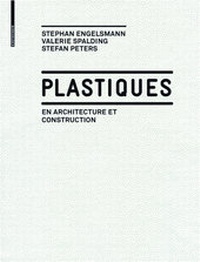
Plastiques
en Architecture et Construction
1st Edition
Published on 12. October 2010
Book
Hardback
176 pages
978-3-0346-0670-7 (ISBN)
Description
Plastics are high-performance materials of wide use in the built environment. Their versatile technical properties are particularly fascinating. A broad range of form-giving and finishing processes makes plastic especially interesting for complex geometries in combination with digital planning processes. Following the pioneering plastic structures of the 1970s, a number of spectacular buildings have in recent years highlighted the outstanding technical and aesthetic potential of the material.Until now, however, there has been no systematic treatment of the use of plastic in architecture. This book seeks to fill that gap by providing an introduction to the structural and design possibilities of plastic. It introduces the material and its specific characteristics, describes various types of plastic in terms of their relevance for building, explains processing technologies and presents typical products and components. A concise presentation of twenty-five international built projects - organized by the type of application and the plastic involved - documents the broad range of plastic in architecture. Finally, a look ahead at the future describes the current state of the art in materials research.
More details
Language
French
Place of publication
Basel/Berlin/Boston
Switzerland
Target group
Professional and scholarly
US School Grade: College Graduate Student
Illustrations
124 s/w Abbildungen, 118 farbige Abbildungen, 2 s/w Tabellen
124 b/w and 118 col. ill., 2 b/w tbl.
Weight
1083 gr
ISBN-13
978-3-0346-0670-7 (9783034606707)
Schweitzer Classification
Other editions
Additional editions
E-Book
11/2012
1st Edition
Birkhäuser
€29.95
Available for download
Book
01/2010
Birkhäuser Verlag GmbH
€49.95
Article exhausted; check different version
Persons
Prof. Dr.-Ing. Stephan Engelsmann ist Bauingenieur. Er studierte Bauingenieurwesen an der TU München und Architektur an der University of Bath. Er war wissenschaftlicher Mitarbeiter bei Jörg Schlaich und arbeitete in verschiedenen Ingenieurbüros. Er ist heute Professor für konstruktives Entwerfen und Tragwerkslehre an der Staatlichen Akademie der Bildenden Künste Stuttgart und er ist Gründungspartner im Ingenieurbüro Engelsmann Peters Beratende Ingenieure in Stuttgart. Valerie Spalding studierte Architektur an der RWTH Aachen. Sie arbeitete in verschiedenen Architekturbüros im In- und Ausland, darunter James Carpenter Design Associates in New York. Seit 2005 ist sie wissenschaftliche Mitarbeiterin an der Staatlichen Akademie der Bildenden Künste Stuttgart und forscht zum Thema Bauen mit Kunststoffen. Dr.-Ing. Stefan Peters ist Bauingenieur. Er studierte an der Universität Stuttgart und war Mitarbeiter in verschiedenen Ingenieurbüros, unter anderem Werner Sobek Ingenieure. Nach einer Tätigkeit als wissenschaftlicher Mitarbeiter an der Universität Stuttgart bei Jan Knippers von 2000 bis 2006 gründete er mit Stephan Engelsmann das Ingenieurbüro Engelsmann Peters Beratende Ingenieure in Stuttgart.
Content
Préface 1 Vers l'architecture en plastique Les Principes 2 Propriétés des matériaux Malléabilité et fabrication des pièces Résistance aux intempéries Propriétés thermiques Combustibilité et inflammabilité Additifs, charges et agents renforçants 3 Connaissance des matériaux Structures des polymères Morphologie des macromolécules Classification des plastiques selon leux taux de réticulation Procédés de synthèse 4 Types de plastiques et fabrication Élastomères Thermoplastiques Matériaux Fabrication Façonnage Recyclage Thermodurcissables Composant des matériaux Fabrication Propriétés La Construction 5 Semi-produits et produits finis Plaques monolithiques Plaques profilées Panneaux sandwich Mousses Profilés Produits spéciaux 6 Construire avec les plastiques Thermoplastiques Vissage Encliquetage Collage Soudage Thermodurcissables Vissage Collage Dimensionnement Résistance et durabilité Exemples et projets 7 Le plastique en fonction enveloppante Chanel Mobile Art Pavilion, Hongkong, Chine; Tokyo, Japon; New York, États-Unis BMW Bubble, Francfort et Berlin, Allemagne Kunsthaus Graz, Graz, Autriche Gare ferroviaire d'Emsdetten, Emsdetten, Allemagne Idee Workstation, Tokyo, Japon Reiss Headquarters, Londres, Grande-Bretagne Bâtiment administratif et de production de Fiberline, Middelfart, Danemark Farben des Konsums, Berlin, Allemagne Laban Creekside, Londres, Grande-Bretagne Terminal V, Lauterach, Autriche Forum Soft, Yverdon, Suisse Polymer Engineering Centre, Melbourne, Australie Le Musée Dornier, Friedrichshafen, Allemagne Centre de conférences et auditorium, Badajoz, Espagne 8 Le plastique en fonction porteuse Sculpture-tour en plastique Stuttgart, Allemagne D-tour, Doetinchem, Pays-Bas Ârret de bus de Hoofddorp, Hoofddorp, Pays-Bas Toiture du centre Yitzhak Rabin, Tel Aviv, Israël Pavillon Verre/GFK, Düsseldorf, Allemagne Structure en plastique plissé, Stuttgart, Allemagne 9 Le plastique en fonction porteuse et enveloppante Clip-On, Utrecht, Pays-Bas Eiertempel, Berne, Suisse Cinq Bulles, Vienne, Autriche fg 2000, Altenstadt, Allemagne Futuro, divers lieux dans le monde MYKO, Weimar et Rostock, Allemagne Bâtiment de réception de Novartis Campus, Bâle, Suisse 10 Perspectives de développement Matériaux ultraperformants pour structures porteuses Matériaux ultraperformants pour enveloppes de bâtiment Combinaison de plusieurs matériaux Renforcement a posteriori des structures porteuses Techniques d'assemblage adaptées aux matériaux Nouveaux modes de production Transfert de technologies Glossaire Bibliographie Les auteurs Remerciements Index des noms et de bâtiments Index de sujets Crédits des illustrations