

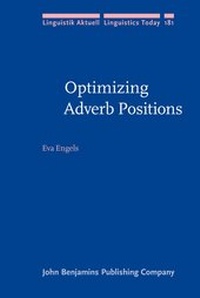
Optimizing Adverb Positions
Published on 8. February 2012
Book
Hardback
347 pages
978-90-272-5564-8 (ISBN)
Description
Adverb positions vary within a single language as well as across diverse languages. Based on the study of adverbs in English, French and German, this monograph shows that the distribution of adverbs is influenced by various factors at distinct levels of linguistic representation - comprising semantics, syntax, phonology and information structure -, which interact in determining adverb positions. The results of the investigation are formulated within the theoretical framework of Optimality Theory, which captures the complex interaction of these factors by hierarchically ranked constraints, deriving cross-linguistic variation of adverb positions by differences in the language-specific constraint hierarchies. The book is divided into two parts: While Part I examines adverb positions in general, Part II investigates under which circumstances an adverb may attach to a phonetically empty constituent in the languages under discussion. The book appeals to a linguistic audience interested in Germanic and Romance languages as well as in theoretical syntax in general.
More details
Series
Language
English
Place of publication
Amsterdam
Netherlands
Target group
Professional and scholarly
Illustrations
+ index
Dimensions
Height: 245 mm
Width: 164 mm
Weight
800 gr
ISBN-13
978-90-272-5564-8 (9789027255648)
Copyright in bibliographic data and cover images is held by Nielsen Book Services Limited or by the publishers or by their respective licensors: all rights reserved.
Schweitzer Classification
Other editions
Additional editions
Eva Engels
Optimizing Adverb Positions
E-Book
02/2012
1st Edition
John Benjamins Publishing Company
€130.99
Available for download
Person
Content
2. Introduction; 3. Chapter 1. Basic assumptions on inputs and output candidates; 4. Chapter 2. Verb movement and adverb placement; 5. Chapter 3. Information structure and adverb placement; 6. Chapter 4. Interim conclusion; 7. Chapter 5. Gap constructions in English; 8. Chapter 6. Other languages; 9. Chapter 7. Conclusion; 10. References; 11. Index