

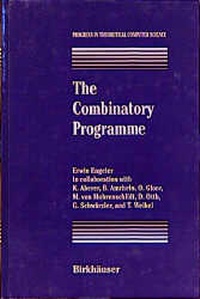
The Combinatory Programme
Published in November 1994
Book
Hardback
VIII, 144 pages
978-3-7643-3801-5 (ISBN)
Description
The purpose of the programme in combinatory logic is to rework the mathematical foundations of computer science on a theory of pure thought. It begins from the idea that, if logic is to be the science of correctly dealing with thought-objects, the underlying theory must be in some sense a part of, or at least a preliminary to, its structure, ie, a protologic. From this idea a combinatory algebra is constructed, using a programmatic mixture of the classical axiomatic and set-theoretic approaches. This text shows that sufficiently rich combinatory algebras can serve as a platform from which to develop the algorithmic aspects of many areas in computer science, mathematics and their applications. It should be of interest to those studying universal algebra, logic and computer algebra.
More details
Other editions
New editions
Erwin Engeler
The Combinatory Programme
Book
11/1994
Birkhauser Boston Inc
€106.99
Shipment within 15-20 days
Content
Part 1 Historical and philosophical background: from protologics to combinatory algebras; a brief recapitulation of combinatory algebra; an algebraization of universal algebra; objects relected in their properties. Part 2 An algebraization of universal algebra: axiomatic extensions; aspects of universal algebra in combinatory logic; remarks on an algebraic theory of recursive degrees. Part 3 An algebraization of formal properties of objects: an algebraization of hierarchical and recursive distributed processes; algebra of approximate computation. Part 4 Relations to logical and computer-algebraic calculi: solving discontinuous ordinary differential equations; types and consistency.