

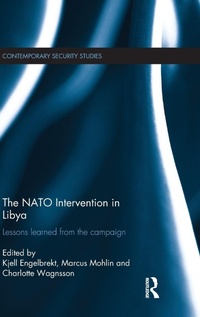
The NATO Intervention in Libya
Lessons learned from the campaign
1st Edition
Published on 9. October 2013
Book
Hardback
272 pages
978-0-415-70549-3 (ISBN)
Description
This book explores 'lessons learned' from the military intervention in Libya by examining key aspects of the 2011 NATO campaign.
NATO's intervention in Libya had unique features, rendering it unlikely to serve as a model for action in other situations. There was an explicit UN Security Council mandate to use military force, a strong European commitment to protect Libyan civilians, Arab League political endorsement and American engagement in the critical, initial phase of the air campaign. Although the seven-month intervention stretched NATO's ammunition stockpiles and political will almost to their respective breaking points, the definitive overthrow of the Gaddafi regime is universally regarded as a major accomplishment.
With contributions from a range of key thinkers and analysts in the field, the book first explains the law and politics of the intervention, starting out with deliberations in NATO and at the UN Security Council, both noticeably influenced by the concept of a Responsibility to Protect (R2P). It then goes on to examine a wide set of military and auxiliary measures that governments and defence forces undertook in order to increasingly tilt the balance against the Gaddafi regime and to bring about an end to the conflict, as well as to the intervention proper, while striving to keep the number of NATO and civilian casualties to a minimum.
This book will be of interest to students of strategic studies, history and war studies, and IR in general.
NATO's intervention in Libya had unique features, rendering it unlikely to serve as a model for action in other situations. There was an explicit UN Security Council mandate to use military force, a strong European commitment to protect Libyan civilians, Arab League political endorsement and American engagement in the critical, initial phase of the air campaign. Although the seven-month intervention stretched NATO's ammunition stockpiles and political will almost to their respective breaking points, the definitive overthrow of the Gaddafi regime is universally regarded as a major accomplishment.
With contributions from a range of key thinkers and analysts in the field, the book first explains the law and politics of the intervention, starting out with deliberations in NATO and at the UN Security Council, both noticeably influenced by the concept of a Responsibility to Protect (R2P). It then goes on to examine a wide set of military and auxiliary measures that governments and defence forces undertook in order to increasingly tilt the balance against the Gaddafi regime and to bring about an end to the conflict, as well as to the intervention proper, while striving to keep the number of NATO and civilian casualties to a minimum.
This book will be of interest to students of strategic studies, history and war studies, and IR in general.
More details
Series
Language
English
Place of publication
London
United Kingdom
Publishing group
Taylor & Francis Ltd
Target group
College/higher education
Illustrations
1 s/w Photographie bzw. Rasterbild, 1 s/w Zeichnung, 3 s/w Tabellen
3 Tables, black and white; 1 Line drawings, black and white; 1 Halftones, black and white
Dimensions
Height: 240 mm
Width: 161 mm
Thickness: 19 mm
Weight
575 gr
ISBN-13
978-0-415-70549-3 (9780415705493)
Copyright in bibliographic data and cover images is held by Nielsen Book Services Limited or by the publishers or by their respective licensors: all rights reserved.
Schweitzer Classification
Other editions
Additional editions
Kjell Engelbrekt | Marcus Mohlin | Charlotte Wagnsson
The NATO Intervention in Libya
Lessons learned from the campaign
Book
06/2015
1st Edition
Routledge
€71.60
Shipment within 10-20 days
Kjell Engelbrekt | Marcus Mohlin | Charlotte Wagnsson
The NATO Intervention in Libya
Lessons learned from the campaign
E-Book
10/2013
1st Edition
Routledge
€64.49
Available for download
Kjell Engelbrekt | Marcus Mohlin | Charlotte Wagnsson
The NATO Intervention in Libya
Lessons learned from the campaign
E-Book
10/2013
1st Edition
Routledge
€64.49
Available for download
Persons
Kjell Engelbrekt is Associate Professor of Political Science at the Swedish National Defence College and member of the Royal Swedish Academy of War Sciences.
Marcus Mohlin is a Commander in the Swedish Navy. He also holds a Ph.D. in Military Sciences and is currently a Researcher at the Swedish National Defence College.
Charlotte Wagnsson is Professor of Political Science at the Swedish National Defence College; she received her Ph.D. in Political Science from Stockholm University.
Marcus Mohlin is a Commander in the Swedish Navy. He also holds a Ph.D. in Military Sciences and is currently a Researcher at the Swedish National Defence College.
Charlotte Wagnsson is Professor of Political Science at the Swedish National Defence College; she received her Ph.D. in Political Science from Stockholm University.
Content
Preface, John Andreas Olsen Introduction, Kjell Engelbrekt and Charlotte Wagnsson Part I: The Law & Politics of Intervention 1. Able but Not Willing: A critical assessment of NATO's Libya Intervention, Jeffrey H. Michaels 2. Why Libya? Security Council Resolution 1973 and the Politics of Justification, Kjell Engelbrekt 3. A legal view on NATO's campaign in Libya, Fredrik A. Holst and Martin Fink Part II: The Military Campaign 4. Executing Strategy from the Air, Anders Nygren 5. Naval operations during the 2011 Libya campaign, Christian Wollert 6. Fragments of an Army - three aspects of the Libya collapse, Karl Soerenson and Nima Damidez Part III: Auxiliary Measures and Arrangements 7. Managing Perceptions: Strategic communication and the story of success in Libya, Rikke Bjerg Jensen 8. Cloak and Dagger in Libya: The Thuwar and the Role of Allied Special Forces, Marcus Mohlin 9. Conclusion: Lessons and Consequences of Operation Unified Protector, Robert Egnell