

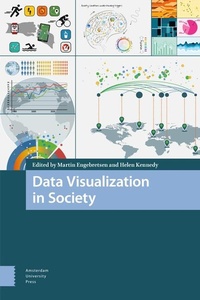
Data Visualization in Society
Published on 16. April 2020
Book
Paperback/Softback
464 pages
978-94-6372-290-2 (ISBN)
Description
Today we are witnessing an increased use of data visualization in society. Across domains such as work, education and the news, various forms of graphs, charts and maps are used to explain, convince and tell stories. In an era in which more and more data are produced and circulated digitally, and digital tools make visualization production increasingly accessible, it is important to study the conditions under which such visual texts are generated, disseminated and thought to be of societal benefit. This book is a contribution to the multi-disciplined and multi-faceted conversation concerning the forms, uses and roles of data visualization in society. Do data visualizations do 'good' or 'bad'? Do they promote understanding and engagement, or do they do ideological work, privileging certain views of the world over others? The contributions in the book engage with these core questions from a range of disciplinary perspectives.
Reviews / Votes
"This book is a good resource for those wanting to study data visualisation in relation to social semiotics and epistemology as the methodologies and frameworks provided by the authors are well thought out and effective lenses for studying data visualisation. [...] This book has achieved its aims of solidifying, as well as inspiring, continuing discourse on the topic of data visualisation and society."- Miriam McBride, Australian Institute of Aboriginal and Torres Strait Islander Studies, Journal of the Australian Library and Information Association, 70:1 (2021)
"The chapters in this expertly edited volume make a crucial contribution to critical studies in the area of data visualization. Focused on a broad range of topics including activism, literacy, accessibility, social disparity, gender politics, and professional practices, the papers demonstrate in case after case the rhetorical power of visualizations and the need to engage critically with that power."
- Johanna Drucker, Breslauer Professor and Distinguished Professor of Information Studies, UCLA
"This book offers unique and much needed perspectives on data visualization culture. While most books still approach the subject in a practical "how to" way, Data Visualization in Society offers a range of critical reflections on key social and culture dimensions of visualization culture. This is the book we have been waiting for."
- Lev Manovich, Professor of Computer Science, The Graduate Center, City University of New York & Director, Cultural Analytics Lab
More details
Language
English
Place of publication
Amsterdam
Netherlands
Target group
Professional and scholarly
Academic
Product notice
Paperback (trade)
Unsewn / adhesive bound
Illustrations
7 s/w Abbildungen, 80 farbige Abbildungen
Dimensions
Height: 231 mm
Width: 155 mm
Thickness: 25 mm
Weight
658 gr
ISBN-13
978-94-6372-290-2 (9789463722902)
Copyright in bibliographic data and cover images is held by Nielsen Book Services Limited or by the publishers or by their respective licensors: all rights reserved.
Schweitzer Classification
Other editions
Additional editions
Martin Engebretsen | Helen Kennedy
Data Visualization in Society
E-Book
10/2025
Routledge
€0.00
Available for download
Martin Engebretsen | Helen Kennedy
Data Visualization in Society
E-Book
10/2025
Routledge
€0.00
Available for download
Martin Engebretsen | Helen Kennedy
Data Visualization in Society
E-Book
04/2020
1st Edition
Amsterdam University Press
€0.00
Available for download
Persons
Martin Engebretsen is Professor of Language and Communication at University of Agder and director of the INDVIL project (indvil.org), which provides the inspiration for this book. Helen Kennedy is Professor of Digital Society at the University of Sheffield. Her research traverses digital landscapes. She is especially interested in the datafication of everyday life.
Content
List of tables, List of figures, Acknowledgements, Foreword: The dawn of a philosophy of visualization, 1. Introduction : The relationships between graphs, charts, maps and meanings, feelings, engagements, Section I Framing data visualization, Section II Living and working with data visualization, Section III Data visualization, learning, and literacy, Section IV Data visualization semiotics and aesthetics, Section V Data visualization and inequalities, Index