

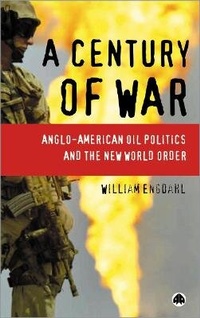
A Century of War
Anglo-American Oil Politics and the New World Order
Will be published approx. on 20. October 2004
Book
Hardback
312 pages
978-0-7453-2310-7 (ISBN)
Description
'This is the only accurate account I have seen of what really happened with the price of oil in 1973. I strongly recommend reading it.' Sheikh Zaki Yamani, former Oil Minister of Saudi Arabia
'I recommend this book to all who wish to know how the world is really run, what are the systems behind the sub-systems we perceive in the daily media, and what are the antecedents of the present global political dilemmas.' Dr Frederick Wills, former Foreign Minister, Guyana
'For those truly interested about how the world economy functions, this book will be greatly useful. The book treats especially well the political goals of Britain, a thread in modern history all too often overlooked.' Stephen J. Lewis, economist, City of London
'... one of the most readable books I have ever seen. It will shock people, but it is needed. William Engdahl has found a common thread that ties hundreds of events which, at first glance, appear to be unassociated.' Leon D. Richardson, Far East Financial columnist, industrialist, advisory board, Sloan School of Management, Massachussetts Institute of Technology
This book is a gripping account of the murky world of the international oil industry and its role in world politics.
Scandals about oil are familiar to most of us. From George W. Bush's election victory to the wars in Iraq and Afghanistan, US politics and oil enjoy a controversially close relationship. The US economy relies upon the cheap and unlimited supply of this single fuel.
William Engdahl takes the reader through a history of the oil industry's grip on the world economy. His revelations are startling. Moving from the post-World War I period up to the present day, he shows how oil is - and has always been - the motivating factor in international policy and conflicts.
Shedding light on the 1970s oil shocks and the grand strategy of Washington after the end of the Cold War, Engdahl presents a convincing case that geopolitics and oil were behind the collapse of the Soviet Union, the breakup of Yugoslavia, the rise and fall of the Taliban. He reveals evidence to show that the US and UK decision to go to war in Iraq was not simply an issue of corporate greed. It was a strategic move to control the world economy for the following half century or more.
'I recommend this book to all who wish to know how the world is really run, what are the systems behind the sub-systems we perceive in the daily media, and what are the antecedents of the present global political dilemmas.' Dr Frederick Wills, former Foreign Minister, Guyana
'For those truly interested about how the world economy functions, this book will be greatly useful. The book treats especially well the political goals of Britain, a thread in modern history all too often overlooked.' Stephen J. Lewis, economist, City of London
'... one of the most readable books I have ever seen. It will shock people, but it is needed. William Engdahl has found a common thread that ties hundreds of events which, at first glance, appear to be unassociated.' Leon D. Richardson, Far East Financial columnist, industrialist, advisory board, Sloan School of Management, Massachussetts Institute of Technology
This book is a gripping account of the murky world of the international oil industry and its role in world politics.
Scandals about oil are familiar to most of us. From George W. Bush's election victory to the wars in Iraq and Afghanistan, US politics and oil enjoy a controversially close relationship. The US economy relies upon the cheap and unlimited supply of this single fuel.
William Engdahl takes the reader through a history of the oil industry's grip on the world economy. His revelations are startling. Moving from the post-World War I period up to the present day, he shows how oil is - and has always been - the motivating factor in international policy and conflicts.
Shedding light on the 1970s oil shocks and the grand strategy of Washington after the end of the Cold War, Engdahl presents a convincing case that geopolitics and oil were behind the collapse of the Soviet Union, the breakup of Yugoslavia, the rise and fall of the Taliban. He reveals evidence to show that the US and UK decision to go to war in Iraq was not simply an issue of corporate greed. It was a strategic move to control the world economy for the following half century or more.
Reviews / Votes
For those truly interested about how the world economy functions, this book will be greatly useful. The book treats especially well the political goals of Britain, a thread in modern history all too often overlooked. -- Stephen J. Lewis, economist, City of London This book is the only accurate account I have seen of what really happened with the price of oil in 1973. I can strongly recommend reading it. -- Sheikh Zaki Yamani, former Oil Minister of Saudi Arabia A more thrilling account of the real world than the most thrilling fictional thriller. I could not put it down - and I learned an enormous amount of important information. -- Andre Gunder Frank ... intellectually penetrating in its grasp of the conditions under which politicians have to operate in the modern world, The scholarship is impeccable and it elucidates the lamentable record of the crimes and fillies of the few who stretched the levers of power almost to the breaking point.I recommend this book to all who wish to know how the world is really run, what are the systems behind the sub-systems we perceive in the daily media, and what are the antecedents of the present global political dilemmas. Above all, I recommend this book to readers in the Third World as a faithful account of why my generation of political leaders failed to achieve the reasonable expectation of their political constituencies... -- Dr Frederick Wills, former Foreign Minister, Guyana This book is not for the timid or the inattentive. It gets down to bed-rock... It is a fine bit of work and defines better the real problem areas of our society... -- Col Fletcher Prouty, USAF (ret.), author, The Secret Team and the real life of Mr.X and JFK movie. ...one of the most readable books I have ever seen. It will shock people, but it is needed. William Engdahl has found a common thread that ties hundreds of events which , at first glance appear to be unassociated... fully surpasses my standards for a worthwhile book -- Leon D. Richardson, Far East Financial columnist, industrialist, advisory board, Sloan School of Management, MITMore details
Language
English
Place of publication
London
United Kingdom
Target group
College/higher education
Professional and scholarly
Product notice
Library binding
Dimensions
Height: 215 mm
Width: 135 mm
ISBN-13
978-0-7453-2310-7 (9780745323107)
Copyright in bibliographic data and cover images is held by Nielsen Book Services Limited or by the publishers or by their respective licensors: all rights reserved.
Schweitzer Classification
Other editions
Additional editions
E-Book
10/2004
1st Edition
Pluto Press
€83.69
Available for download
Person
William Engdahl has written on issues of energy, politics and economics for more than 30 years, beginning with the first oil shock in the early 1970's. He has contributed regularly to a number of publications, including Japan's Nihon Keizai Shimbun, Foresight magazine; Grant'sInvestor.com, European Banker and Business Banker International. He has also spoken at numerous international conferences on geopolitical, economic and energy subjects, and is active as a consulting economist.
Content
Foreword
1. The Three Pillars of the British Empire
2. The Lines are Drawn: Germany and the Geopolitics of the Great War
3. A Global Fight for Control of Petroleum Begins
4. Oil Becomes the Weapon, the Near East the Battleground
5. Combined & Conflicting Goals: U.S. rivals Britain
6. The Anglo-Americans Close Ranks
7. Oil and a New World Order of Bretton Woods
8. A Sterling Crisis and the Adenauer-de Gaulle Threat
9. Running the world economy in reverse: Who made the 1970's oil shocks?
10. Europe, Japan and a Response to the Oil Shock
11. Imposing the New World Order
12. From Evil Empire to the Axis of Evil
13. A New Millennium for Oil Geopolitics
Appendices
Index of names
1. The Three Pillars of the British Empire
2. The Lines are Drawn: Germany and the Geopolitics of the Great War
3. A Global Fight for Control of Petroleum Begins
4. Oil Becomes the Weapon, the Near East the Battleground
5. Combined & Conflicting Goals: U.S. rivals Britain
6. The Anglo-Americans Close Ranks
7. Oil and a New World Order of Bretton Woods
8. A Sterling Crisis and the Adenauer-de Gaulle Threat
9. Running the world economy in reverse: Who made the 1970's oil shocks?
10. Europe, Japan and a Response to the Oil Shock
11. Imposing the New World Order
12. From Evil Empire to the Axis of Evil
13. A New Millennium for Oil Geopolitics
Appendices
Index of names